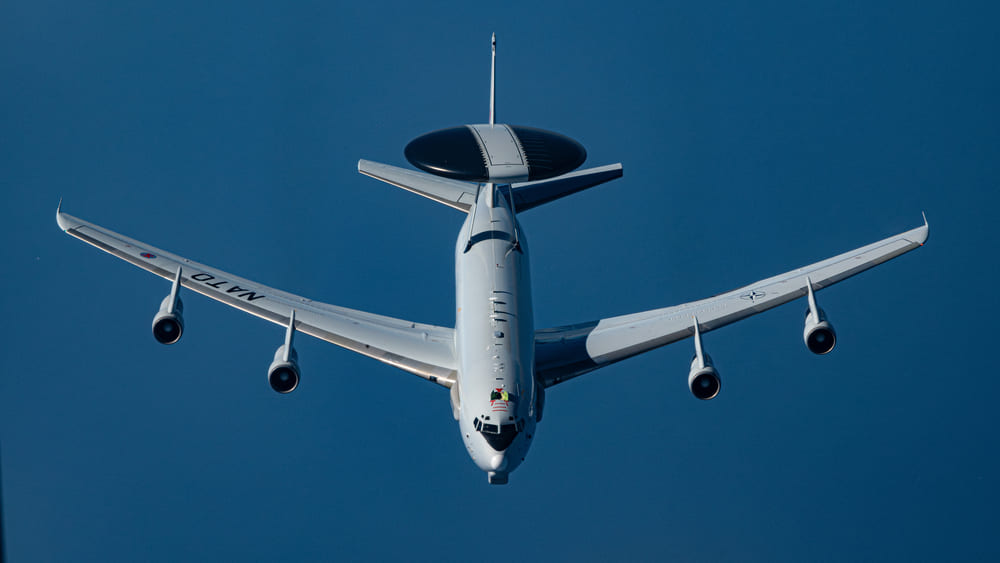
On Dec. 18, 2025, public flight data placed a U.S. Air Force E-3 Sentry off Venezuela’s northern coast after several days in which that aircraft type had not shown with any regularity in the southern Caribbean. The track appeared inside a wider run of visible U.S. military activity near Venezuelan airspace. Navy fighters, electronic attack jets, and a carrier-based radar aircraft had already shown up on open feeds in the same zone. According to industry sources, the E-3’s return to public view added a different level of command-and-control presence to an air picture that was already busier than usual.
E-3 Sentry AWACS Flight Appears Off Venezuela After Days of Sparse Public Tracks
The aircraft stood out because the E-3 is not a routine background platform in this story. It is the Air Force’s long-range airborne warning and control jet, built to scan wide air and sea space, sort traffic, move data across a force package, and support battle management from altitude. Open trackers had already shown Navy aircraft working close to Venezuela’s northern edge on Dec. 18. The Sentry brought a broader joint-air function into that visible pattern. Public visibility alone did not prove a pending strike order, but it widened the set of capabilities that Washington was willing to let outside observers see.
Nine days earlier, two U.S. Navy F/A-18s flew over the Gulf of Venezuela for more than 30 minutes. Defense officials confirm the jets remained in international airspace, and one official described the mission as a “routine training flight.” The run still drew notice because the route placed fast jets over a narrow body of water bounded by Venezuela and close to the country’s northern coast. The same report said these were the closest publicly known U.S. warplane tracks to Venezuelan territory since the current pressure campaign began.
Open-source data on Dec. 18 showed more than one aircraft type near the coast. A Super Hornet flew repeated loops near the edge of Venezuelan airspace. Two EA-18G Growlers, two additional Super Hornets, and an E-2D Hawkeye were also visible in the same broad area. That was a denser package than a single demonstration flight. It pointed to layered airborne surveillance, electronic support, and tactical aviation working inside the same operating picture.
Civil aviation warnings and one serious near miss added another piece to the same picture. On Nov. 21, the FAA issued a 90-day advisory for the Maiquetia flight information region and told operators to use caution at all altitudes because of worsening security conditions and heightened military activity in or around Venezuela. On Dec. 12, a JetBlue A320 departing Curacao took evasive action about 40 miles off Venezuela’s coast after encountering a U.S. Air Force tanker with no active transponder. Air traffic audio captured the airline pilot saying the aircraft crossed directly through the jet’s path at the same altitude.
That sequence gave the Dec. 18 E-3 track more weight than a single icon on a civilian map. Airspace around Venezuela had already become more crowded, less predictable, and more openly military. Publicly visible tactical flights sat alongside non-visible military traffic, FAA warnings, and at least one civilian encounter with an untracked U.S. aircraft. The Sentry entered that environment as the first clearly visible AWACS layer in several days.
E-3 Sentry Battle Management Adds a Joint Air-Control Layer Beyond the E-2D Hawkeye
The Air Force describes the E-3 as an integrated command-and-control battle-management, surveillance, target-detection, and tracking platform. Its radar and mission crew can find, fix, and track airborne or maritime threats and identify emitters across a large operating area. That role goes beyond simple airborne observation. The aircraft can hold a wide tactical picture overhead and pass it to commanders who need one set of data across multiple services and aircraft types.
Carrier aviation already had an airborne early-warning asset in the region. The E-2D Hawkeye remained part of the visible Navy package near Venezuela, and naval material describes its APY-9 radar as a system built for surveillance, detection, and tracking against advanced threats over land, littoral zones, and open ocean. The E-2D is a very capable aircraft. The E-3 fits a different slot. It sits higher, covers a broader joint force, and plugs more naturally into Air Force and theater-level air-control architecture when the mission reaches past one carrier air wing.
The choice to let an E-3 appear on public feeds therefore carried its own signal. Washington had already used visible military tracks near Venezuelan airspace as part of a coercive pattern. The Sentry was consistent with that approach, but it brought a different function into open view. A tanker says one thing. A fighter patrol says another. An AWACS orbit suggests oversight of a wider and more mixed force, especially when Navy aircraft, electronic-attack jets, and carrier radar planes are already nearby.
That does not place the United States on the edge of a land campaign. The force in theater still lacked the scale for a large ground operation against Venezuela. Even so, the Sentry’s appearance pointed to a more mature air structure over the southern Caribbean. It fit a force that was already combining sea control, tactical aviation, tanker support, drones, and amphibious elements under one pressure campaign.
USS Gerald R. Ford Strike Group and 15,000 U.S. Troops Expand Operation Southern Spear
The E-3 sortie came amid a force concentration that had grown far beyond routine counter-drug patrols. Reuters reported on Nov. 11 that the Gerald R. Ford carrier strike group had moved into the Latin America region after President Donald Trump ordered the deployment. The carrier added to eight warships, a nuclear submarine, and F-35 aircraft already in the Caribbean. The Pentagon said the deployment would help “disrupt narcotics trafficking and degrade and dismantle Transnational Criminal Organizations.”
Two weeks later, the Navy said the Ford strike group had entered the Caribbean on Nov. 16. In a Dec. 1 release, Rear Adm. Paul Lanzilotta said SOUTHCOM tasking had become “priority number one” for the strike group and tied the mission to “upholding law and order across the Western Hemisphere.” The same release said the carrier group was operating as part of Joint Task Force Southern Spear alongside additional joint forces, including the Iwo Jima Amphibious Ready Group.
By Dec. 18, the regional inventory was unusually large. Associated Press reporting put the total at about 15,000 personnel, with nearly 10,000 sailors and Marines aboard warships. Lt. Col. Emanuel Ortiz of U.S. Southern Command said the figure “includes all military services and government civilians in support of this mission.” Separate reporting and official imagery tied the deployment to at least 11 surface warships, a carrier air wing built around Super Hornets, Growlers, and E-2Ds, plus amphibious forces, Marine air assets, drones, and other support aircraft.
Tanker support had grown with the rest of the force. Public reporting in mid-December said KC-46 sorties had continued from the U.S. Virgin Islands and that at least 10 KC-135s were in the Dominican Republic. That kind of refueling backbone does not answer every question about next steps, but it does support sustained air activity over the southern Caribbean, including sorties that begin outside immediate Venezuelan range and still need time on station. The E-3 sighting sat comfortably inside that support picture.
The maritime side of the campaign had hardened at the same time. Reuters reported that U.S. authorities seized the tanker M/T Skipper off Venezuela’s coast on Dec. 10, just before a court-approved warrant expired. The vessel had loaded about 1.8 million barrels of Merey crude at Jose. Four days later, Reuters also reported that officials were preparing to go after additional ships moving Venezuelan oil.
Trump then escalated the oil pressure on Dec. 16 with a public order for a “TOTAL AND COMPLETE BLOCKADE OF ALL SANCTIONED OIL TANKERS” entering or leaving Venezuela. Caracas rejected the move at once. The blockade announcement followed the Skipper seizure and landed while U.S. military air and sea traffic around Venezuela was already thickening. An E-3 in that environment did not look detached from the broader campaign. It looked aligned with a theater that was shifting from scattered demonstrations to a steadier coercive posture.
House War Powers Vote, FAA Warning, and Regional Moves Frame the Venezuela Crisis
Congress had not closed off the administration’s room to maneuver by Dec. 18. Reuters reported that the House voted 216 to 210 against one resolution that would have removed U.S. armed forces from hostilities with presidentially designated terrorist organizations in the Western Hemisphere unless Congress approved them. It also voted 213 to 211 against a second resolution directing the president to remove U.S. forces from hostilities with or against Venezuela without congressional authorization. Both votes broke almost entirely along party lines.
The legal framework behind that fight has not changed. Under 50 U.S. Code section 1543, the president must report to Congress within 48 hours when U.S. forces are introduced into hostilities, into situations where imminent hostilities are clearly indicated, or into the territory, airspace, or waters of a foreign nation while equipped for combat. Section 1544 sets a 60-day limit unless Congress authorizes further action, with a possible 30-day extension under specific conditions. Trump said on Dec. 18 that he “wouldn’t mind” telling Congress before land attacks, but insisted he did not have to.
Regional governments had started to move around the crisis even before the E-3 appeared on public trackers. Reuters reported on Dec. 11 that Brazilian President Luiz Inacio Lula da Silva had spoken with Nicolas Maduro about the situation in the Caribbean and South America after raising concerns over the growing U.S. military presence. On Dec. 17, Reuters reported that Venezuela requested a U.N. Security Council meeting over what it called “ongoing U.S. aggression.” That same week, Trinidad and Tobago approved transit through its airports for U.S. military aircraft and described the planned movements as logistics-related.
None of those diplomatic or legal moves reduced the visible military pressure on Dec. 18. The southern Caribbean still held a carrier strike group, amphibious forces, tactical aircraft, tankers, and now an openly visible E-3 Sentry. The FAA warning was still in force. Public trackers still showed Navy aircraft near Venezuela’s northern edge. Oil pressure had just intensified. Our analysis shows the Sentry’s appearance was not a stray radar return in an already noisy region. It marked the arrival of a higher-level air-control asset inside a campaign that had become more joint, more deliberate, and more exposed to public view.
REFERENCE SOURCES
- https://www.twz.com/news-features/e-3-sentry-joins-u-s-combat-aircraft-tracked-off-venezuelan-coast
- https://apnews.com/article/venezuela-us-military-trump-fa18-fighter-jets-06fd7cdc5ac26e7a46165431b95508b0
- https://www.faa.gov/air_traffic/publications/us_restrictions/venezuela/KICZ-Advisory-NOTAM-A0012-25.pdf
- https://www.reuters.com/world/americas/jetblue-flight-averts-mid-air-collision-with-us-air-force-jet-2025-12-15/
- https://www.af.mil/About-Us/Fact-Sheets/Display/Article/104504/e-3-sentry-awacs/
- https://navalaviationnews.navy.mil/Editorial-Staff-Tools/Article-Submission/Article/4347818/us-french-in-flight-refueling-extends-advanced-hawkeyes-reach/
- https://www.reuters.com/business/aerospace-defense/us-aircraft-carrier-moves-into-latin-america-region-officials-say-2025-11-11/
- https://www.navy.mil/Press-Office/News-Stories/display-news/Article/4344883/uss-gerald-r-ford-arrives-in-st-thomas-us-virgin-islands/
- https://apnews.com/article/us-military-warships-troops-venezuela-caribbean-f0cea0fbfcd991066b2489460f685001
- https://www.reuters.com/business/energy/us-seized-tanker-near-venezuela-just-warrant-was-set-expire-court-document-shows-2025-12-13/
- https://www.reuters.com/world/americas/trump-orders-blockade-sanctioned-oil-tankers-leaving-entering-venezuela-2025-12-16/
- https://www.reuters.com/world/us/us-house-defeats-bids-rein-trump-venezuela-campaign-2025-12-17/
- https://www.law.cornell.edu/uscode/text/50/1543
- https://www.law.cornell.edu/uscode/text/50/1544
- https://www.reuters.com/world/americas/lula-maduro-spoke-about-situation-caribbean-south-america-brazils-government-2025-12-11/
- https://www.reuters.com/world/americas/venezuela-requests-un-security-council-meet-over-ongoing-us-aggression-2025-12-17/
- https://www.reuters.com/world/americas/trinidad-tobago-approves-us-military-aircraft-transit-airports-2025-12-15/