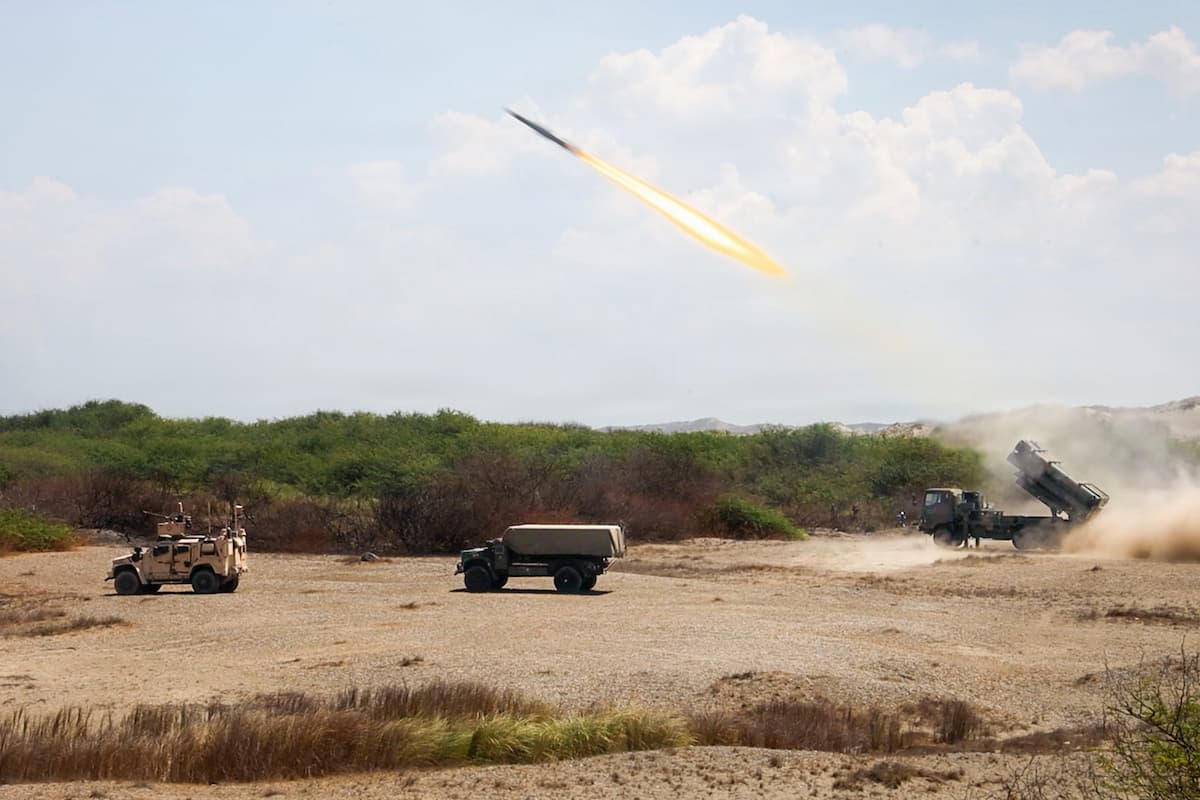
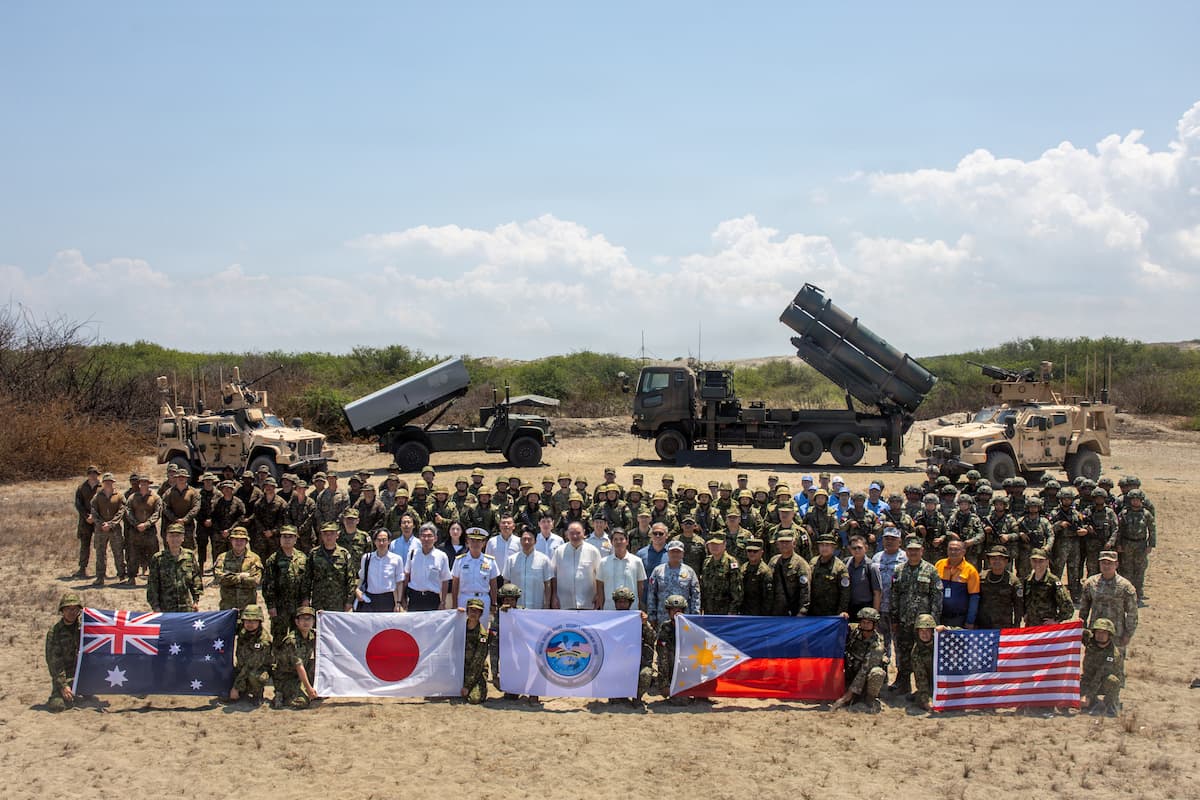
The Type 88 firing during Balikatan 2026 was made possible by the Japan-Philippines Reciprocal Access Agreement. Read article by article, the agreement lets Japanese forces come, bring weapons and fire them with Manila’s consent, but it provides no basis for Japanese military facilities and contains no provision for prepositioning. A lasting Type 88 presence would more likely come as Philippine-owned systems, through equipment transfers.
On May 6, 2026, Japan’s Ground Self-Defense Force fired its Type 88 surface-to-ship missile system from the Philippines, the first live fire of the system on Philippine soil. Two missiles were launched. Video released by the U.S. Marine Corps shows the first striking the ship and the second missing it. Japan’s Ministry of Defense described it as the first-ever live-fire exercise of the Type 88 in the country, conducted in Ilocos Norte as part of Exercise Balikatan 2026 and observed by Defense Minister Shinjiro Koizumi and Philippine Defense Secretary Gilberto Teodoro Jr.
The agreement that made the launch possible is narrower than its effect suggests. It gives Japanese forces a legal framework to visit, train and carry weapons in the Philippines when both governments agree on a specific activity. It states that nothing in it provides a basis for either country to establish military facilities on the other’s territory.
- Full title
- Agreement between Japan and the Republic of the Philippines Concerning the Facilitation of Reciprocal Access and Cooperation between the Self-Defense Forces of Japan and the Armed Forces of the Philippines
- Signed
- July 8, 2024, in Manila
- In force
- September 11, 2025, after diplomatic notes were exchanged on August 12, 2025
- First applied
- Announced October 7, 2025: a bilateral disaster-relief exercise, Doshin-Bayanihan 5-25, and relief deliveries after the Cebu earthquake
- Scope
- “Mutually determined cooperative activities” in the host country; no activity without the host’s consent
- Weapons
- May be carried in circumstances the host approves; transported and stored under the host’s procedures, with advance notice of types, quantities and schedule
- Facilities
- Requested by the visitor; the host makes reasonable efforts to provide them, sets the conditions and keeps overall control; no basis for either side’s military facilities
- Termination
- Six months’ written notice by either party
- Balikatan 2026
- April 20 to May 8, 2026; about 1,400 Japanese personnel, with Type 88 surface-to-ship missile systems among the assets
What happened on May 6
The firing was one of eight training events Japan’s Joint Staff Office listed for its Balikatan 2026 participation, which ran from April 20 to May 8 and drew about 1,400 Japanese personnel along with the helicopter destroyer Ise, the destroyer Ikazuchi, the tank landing ship Shimokita, C-130H and US-2 aircraft, and Type 88 systems. The Joint Staff Office announcement stated the legal basis in one sentence: “with the application of the Japan–Philippines Reciprocal Access Agreement (RAA), the JSDF will conduct field training involving the use of weapons within Philippine territory.”
The Ground Self-Defense Force said in a post on its official X account on May 6, with video of the launch, that its Northern Army conducted the firing to improve joint anti-ship combat capability with U.S. and Philippine forces. According to the U.S. military account of the event, the combined force struck the decommissioned Philippine Navy ship BRP Quezon (PS-70) with a Type 88 missile on the first day of a two-day maritime strike, while U.S. Army HIMARS also delivered strikes. “Deploying the Type-88 Surface-to-Ship Missile in this complex MARSTRIKE allowed us to validate our tactical integration with U.S. and Philippine forces,” said Lt. Col. Ishikawa Daisuke, a public affairs officer with Japan’s Joint Staff Office. Japan’s Ministry of Defense places the firing in Ilocos Norte, Laoag City; U.S. military imagery identifies the site as the Paoay Sand Dunes.
What the agreement permits
The RAA is a status-of-forces agreement for visits. Its stated purpose is to establish “a framework for the conduct of” defense cooperation and to define the status of a visiting force. Its key permissions are procedural:
Access by agreement. The agreement applies only to “mutually determined cooperative activities” in the host country (Article IV.1). A “Visiting Force” is defined as one present “with the consent of the other Party” in connection with those activities (Article I). Japanese releases reflect that design: Tokyo and Manila “decided that the Japan-Philippines Reciprocal Access Agreement … will be applied” to a specific exercise and relief operation, a decision announced on October 7, 2025, and the agreement was again applied to Balikatan in 2026. Each application passes through the agreement’s Joint Committee: the first rested on arrangements the committee made on September 30, 2025, under Article XXVII.6.
Weapons under host rules. Members of a visiting force may carry weapons and ammunition when authorized by their own government “and in circumstances approved by the Receiving State” (Article XII). The visiting force may transport, store and handle weapons, ammunition and explosives for cooperative activities, under the sending state’s responsibility but “in accordance with the procedures and requirements determined by the Receiving State,” and must notify the host in advance of their “types, quantities and transportation schedule” (Article XIV). No Article XIV notifications for Balikatan 2026 have been made public.
Movement on the host’s terms. The host may prescribe routes, restrict movement and prohibit access to specified areas, airspace and facilities (Article V.3). Visiting forces remain under their own national command (Article XXI.1).
What it does not
Two provisions draw the line that much of the coverage missed. Article VIII.1 lets the visiting side request access to facilities and areas; the host “shall make reasonable efforts” to address the request and sets the conditions, and under Article VIII.2 it keeps “overall control” of what it provides. Article VIII.3 then states: “Nothing in this Agreement shall be construed as providing a basis for a Party to establish its military facilities in the territory of the other Party.”
Article IV.1 adds that nothing in the agreement provides a basis for either force “to conduct activities in the territory of the other Party without its consent.” The agreement contains no provision for prepositioning equipment, and either party may terminate it on six months’ written notice (Article XXIX.4). Japan’s Foreign Ministry described the agreement in the same terms on August 12, 2025, when the two governments exchanged the notes that brought it into force: one that “establishes procedures” for cooperative activities by a visiting force and “defines a status of the visiting force,” facilitating joint exercises and disaster relief.
Closer to 1998 than to 2014
The Philippines already has two access agreements with the United States that show where the RAA sits. The 1998 Visiting Forces Agreement covers U.S. personnel present “in connection with activities approved by the Philippine Government.” The 2014 Enhanced Defense Cooperation Agreement goes further: it lets U.S. forces preposition equipment and build at “Agreed Locations.”
| U.S.-Philippines VFA (1998) | U.S.-Philippines EDCA (2014) | Japan-Philippines RAA (2024) | |
|---|---|---|---|
| Presence | Temporary, for activities approved by the Philippines | Rotational access to Agreed Locations, as mutually determined | For mutually determined cooperative activities, with consent |
| Prepositioning | Not provided | Authorized at Agreed Locations, with advance notice of quantities and delivery schedules | Not provided |
| Construction and facilities | Not provided | U.S. operational control of Agreed Locations for construction | Expressly no basis for military facilities |
| Weapons and equipment | Duty-free import; title stays with the U.S. | Prepositioned materiel for exclusive U.S. use; U.S. may remove it at any time | Carried, transported and stored under host procedures, with advance notice |
| Termination | 180 days’ notice | Initial 10-year term, then one year’s notice | Six months’ notice |
Even EDCA, the most permissive of the three, records in its preamble an understanding that the United States will not establish “a permanent military presence or base” in the Philippines. The RAA’s closest equivalent, a bar on military facilities, sits in the operative text rather than a preamble, and does not include EDCA’s prepositioning or construction authorities. By structure, it is the Japanese counterpart of the 1998 agreement.
The 1998 agreement also shows how far a visiting-forces framework can stretch. A U.S. special operations task force advised Philippine forces in the south for 13 years, from 2002 until 2015, with the VFA governing its presence. What the RAA lacks, as the VFA did, is authority to keep equipment in the country between activities or to build for it, and every Japanese deployment still needs Manila’s consent for a specific activity.
The path to staying: transfers
If Type 88 missiles are to remain in the Philippines, the more likely route is a transfer that makes them Philippine equipment under Philippine command. The bilateral process for that route began the day before the Type 88 firing. On May 5, Koizumi and Teodoro signed a statement on defense equipment and technology cooperation in which Koizumi explained Japan’s recent revision of its Three Principles on Transfer of Defense Equipment and Technology. The ministers agreed to discuss transfers “including TC‑90 aircraft and Abukuma‑class destroyers” and to set up a working group covering not only the equipment but training, maintenance and sustainment, and “appropriate management of transferred equipment.”
By May 31, the two ministers had reached a broad consensus to proceed with discussions toward transferring the Abukuma-class destroyers promptly after decommissioning and one TC-90 aircraft within Japan’s fiscal 2027, following a leaders’ summit on May 28. The Type 88 does not appear in either written statement. Kyodo News reported on May 15 that the government was considering exporting the system; asked about it that day, Koizumi said nothing had been decided and that the new working group would identify the equipment to discuss. After the May 31 meeting he told reporters that he and Teodoro had confirmed they would discuss the possible transfer of other equipment, including the surface-to-ship missiles the Philippines has shown interest in.
What to watch
Three things will show whether the May 6 launch stays a demonstration or becomes a presence. The first is how often the two governments apply the RAA and to what: each application is a separate decision, and those announced so far include disaster-relief training, earthquake relief and field training in Balikatan. The second is the working group’s equipment list; a Type 88 transfer would have to appear there before it appears on Philippine soil under Philippine command. The third is the agreement on the protection of classified military information, whose negotiations the ministers said on May 31 had formally begun. The Acquisition and Cross-Servicing Agreement signed in January entered into force on August 22, 2026. None of those steps would change what the RAA itself permits.
Sources
Primary and official documents
- Ministry of Foreign Affairs of Japan — Agreement between Japan and the Republic of the Philippines Concerning the Facilitation of Reciprocal Access and Cooperation between the Self-Defense Forces of Japan and the Armed Forces of the Philippines, signed July 8, 2024
- Ministry of Foreign Affairs of Japan — Exchange of Diplomatic Notes for Entry into Force of the Japan-Philippines Reciprocal Access Agreement, August 12, 2025
- Ministry of Foreign Affairs of Japan — Joint Committee Meeting under the Japan-Philippines Reciprocal Access Agreement, October 7, 2025
- Japan Ministry of Defense — First application of Japan-Philippines Reciprocal Access Agreement, October 7, 2025
- Joint Staff Office, Japan Ministry of Defense — Participation in the U.S.-Philippines hosted Multinational Exercise BALIKATAN 26, April 2026
- Japan Ministry of Defense — Statement by the Defense Ministers of Japan and the Philippines on the Further Promotion of Defense Equipment and Technology Cooperation, May 5, 2026
- Japan Ministry of Defense — Defense Minister Koizumi’s Visit to the Republic of the Philippines, May 2026
- Japan Ministry of Defense — Press conference by Defense Minister Koizumi, May 15, 2026 (in Japanese)
- Japan Ministry of Defense — Japan-Philippines Defense Ministerial Meeting (Joint Press Statement), May 31, 2026
- Japan Ministry of Defense — Extraordinary press conference by Defense Minister Koizumi, Singapore, May 31, 2026 (in Japanese)
- Ministry of Foreign Affairs of Japan — Exchange of Diplomatic Notes for the Entry into Force of the Japan-Philippines Agreement Concerning Reciprocal Provision of Supplies and Services, July 23, 2026
- U.S. Department of State — Agreement Between the United States of America and the Philippines on Enhanced Defense Cooperation, signed April 28, 2014 (TIAS 14-625)
- U.S. Department of State — Agreement Between the United States of America and the Philippines Regarding the Treatment of United States Armed Forces Visiting the Philippines, signed February 10, 1998 (TIAS 12931)
- DVIDS — Multinational forces sink decommissioned ships in Maritime Strike during Balikatan 2026, May 7, 2026
- DVIDS — Balikatan 2026 B-Roll: JTF MARSTRIKE, U.S. Marine Corps video by Lance Cpl. Jeffrey Pruett, May 6, 2026
- Japan Ground Self-Defense Force (@JGSDF_pr) on X — Post with video of the Type 88 firing, May 6, 2026