China’s state aircraft group says its large jet-powered Jiutian uncrewed aircraft completed its first flight Thursday at Pucheng in Shaanxi province. AVIC described the drone as having “a large payload, high operational ceiling, wide speed range, and short takeoff and landing capabilities.”
The company lists a 16-ton maximum takeoff weight and a 6,000-kilogram payload. Jiutian is not just a sensor truck. The aircraft has been shown with a large internal bay marketed for releasing swarms of smaller drones.
AVIC confirms Jiutian SS-UAV first flight at Pucheng in Shaanxi
AVIC’s announcement framed Jiutian as a “general-purpose” platform built around a modular mission payload concept. The design work came from AVIC’s First Aircraft Design and Research Institute under a commission from Shaanxi Unmanned Equipment Technology Company, a state-owned aviation enterprise.
Video aired by state media shows a single aircraft taking off, flying a short profile, then returning to land at the same site. Defense officials confirm the aircraft carries the same “No 004” marking seen on the display airframe that appeared at the 2024 Zhuhai Airshow.
The public branding still looks unsettled. Jiutian is the name AVIC uses in its flight statement, and several reports also refer to the aircraft as “SS-UAV.” Open reporting expands that as “smart-configuration support-UAV.” Another label, “Jetank,” has appeared in foreign press coverage tied to the same airframe.
The first flight itself did not come with a detailed test report. State reporting said engineers checked overall design and basic flight performance. AVIC did not publish a timeline for the next sorties, and it did not release photos of onboard systems beyond external views of the airframe.
Jiutian performance figures include 16 ton takeoff weight and 6 ton payload
AVIC lists Jiutian at 16.35 meters long with a 25-meter wingspan. The company also lists up to 12 hours of endurance and a 7,000-kilometer ferry range. It gives a highest operational altitude of 15 kilometers.
Speed figures disclosed around the program indicate a wide envelope. One set of manufacturer data lists a top speed of about 378 knots and a lower bound near 108 knots, numbers that fit a platform designed to loiter, move cargo, or carry stores across distance.
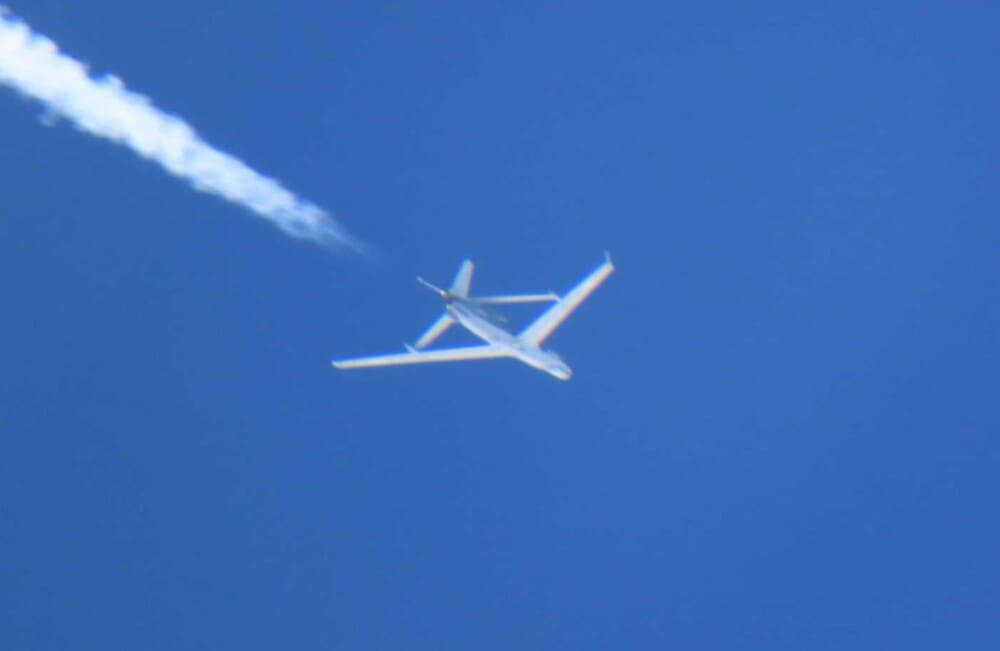
The airframe layout points to a heavy, utility-focused jet UAV. Photos show a high-mounted wing with small winglets, an H-tail, and a single engine mounted above the rear fuselage. The landing gear retracts into pods under the wing roots, which leaves the belly free for a large internal bay.
A 6,000-kilogram payload rating puts Jiutian in a different weight class than the armed turboprop drones that dominate day-to-day strike footage from recent wars. Even compared to larger Western systems, the published payload number is high. It suggests an aircraft built to carry stores first and then accept different mission kits.
Range and endurance claims also line up with the aircraft’s marketing as a “general-purpose” platform. AVIC’s statement tied the drone to civil tasks such as heavy cargo delivery, emergency communications, disaster relief support, geographic surveying, and mapping. A platform built for those jobs needs space and lift more than it needs sprint speed.
The one performance detail AVIC pushed hardest in its short release was flexibility across missions. It tied that to modular payload swaps, not to a single sensor or a single weapon package. That approach helps explain why the design has a big bay and lots of external real estate for antennas, pods, or stores.
Hive module bay and eight hardpoints support drone swarms and strike loads
Jiutian drew attention at Zhuhai because the modular payload bay was not presented as a simple cargo hold. The display carried signage that translated awkwardly into English, with one line reading “Isomerism Hive Module.” Subsequent state reporting described the intent as a drone swarm launch capability rather than a chemistry reference.
According to industry sources, the belly bay is partitioned and sized to hold more than 100 loitering munitions or small attack drones in a compartmentalized arrangement. That matches the way the airframe presents itself in photos. The fuselage depth and the landing gear arrangement both leave room for a long, boxy internal volume.
The swarm concept does not need exotic theory to make sense. A large carrier drone can launch many small air vehicles close to a target area, then remain outside the densest air defenses. The small drones can spread out and take different roles. Some can scout. Others can jam or relay signals. Others can carry small warheads.
A carrier aircraft also reduces pressure on ground launchers. A unit can load drones on a single airframe, fly them to a release point, and recover the carrier to reload. That cycle differs from one-way systems that require a new launcher setup each time. The trade is cost and complexity on the mothership side, since the carrier becomes a high-value asset once it carries so many drones.
External stores matter here too. The Zhuhai display showed eight underwing hardpoints, and state reporting says the modular design can accept guided bombs, air-to-air missiles, cruise missiles, and loitering munitions. That list reads like a general catalogue, but it still signals how AVIC wants buyers to think about the aircraft. It is not a one-mission drone.
That pitch fits with how the aircraft has been described in Chinese reporting. One account called it a “mothership of small drones,” a phrase that keeps coming up in coverage of the internal bay. Wang Yanan, chief editor of Aerospace Knowledge magazine, said “each Jiutian can bring a lot of munitions or equipment.”
The way the bay gets used will decide how much of this stays as airshow marketing. The aircraft needs safe separation for dozens of small drones in close succession. It also needs mission control links that can manage many vehicles at once. China has shown rapid progress in small drone swarming in demonstrations and exercises, but Jiutian adds a new layer by moving the launch point into the air.
AVIC has not released a diagram that shows bay doors, ejection methods, or the arrangement of launch tubes. State media video tied to the first flight did not show bay operations. For now the swarm role remains tied to claims and airshow visuals, not to a public demonstration.
Sensors, communications and cargo roles point to broader missions beyond strike
Photos and video show a sensor turret under the nose, the sort usually fitted with electro-optical and infrared cameras. A dome on the forward fuselage suggests a beyond-line-of-sight communications antenna, and the nose radome indicates room for a radar.
Those features point to surveillance and relay missions that do not rely on weapons at all. A large airframe can host more power generation and more cooling than smaller drones, which helps once operators start stacking radios, datalinks, and sensors. A high ceiling also helps line-of-sight communications coverage, especially over water or rough terrain.
Civil-use messaging in AVIC’s release stayed prominent. The company listed heavy cargo delivery to remote regions, emergency communications restoration, disaster relief equipment delivery, and mapping work. State reporting also listed roles such as maritime patrol, forest fire suppression, disaster assessment, mineral survey, and cultural relic survey.
A single aircraft cannot excel at every one of those missions without tradeoffs, but a big modular bay does make multi-role kits realistic. A cargo pallet load differs from an electronic relay package. The aircraft does not need a new airframe for each. It needs a payload kit, operators, and flight approvals.
That civil framing also gives Beijing room to market Jiutian without placing every discussion inside a combat context. Chinese firms have long sold drones abroad with dual-use narratives, and a large UAV presented as a logistics and disaster-response tool fits that pattern.
The military side remains obvious all the same. A 6,000-kilogram payload and eight hardpoints invite strike loadouts. An internal bay advertised for swarms invites saturation tactics, decoys, and distributed sensing. A radar and long-range communications support maritime search and targeting chains. Those are all familiar mission sets in modern air power, but the airframe size changes how many systems can ride on one platform.
Our analysis shows Jiutian’s first flight moves the program from airshow claims into flight-test reality, with published payload and bay volume that support a true carrier role for swarms, not just a single-drone strike platform.
REFERENCE SOURCES
- https://english.news.cn/20251211/ed59774ceb014454af5f116c30de3c57/c.html
- https://www.news.cn/20251211/9f77981e61604643ab6087b5de377681/c.html
- https://www.chinadaily.com.cn/a/202512/12/WS693b5609a310d6866eb2e363.html
- https://www.janes.com/osint-insights/defence-news/defence/chinas-jiutian-drone-swarm-launching-uav-conducts-first-flight
- https://www.flightglobal.com/defence/china-flies-jiutian-heavy-drone-mothership/156340.article
- https://www.japantimes.co.jp/news/2025/12/11/asia-pacific/china-first-flight-drone-mothership/
- https://www.golem.de/news/jiutian-chinas-drohnenmutter-bereit-fuer-schwarmstart-und-schwere-nutzlasten-2512-193050.html
- https://en.shaanxi.gov.cn/news/sn/202512/t20251212_3595335.html