NATO’s new industry strategy was endorsed the same week as its $50 billion procurement headline. The strategy’s own text says it carries no legal or funding force and covers only the pre-competitive phase. The agency that actually negotiates and signs joint-procurement contracts is a pre-existing part of the NATO Enterprise whose procedures the strategy leaves in place.
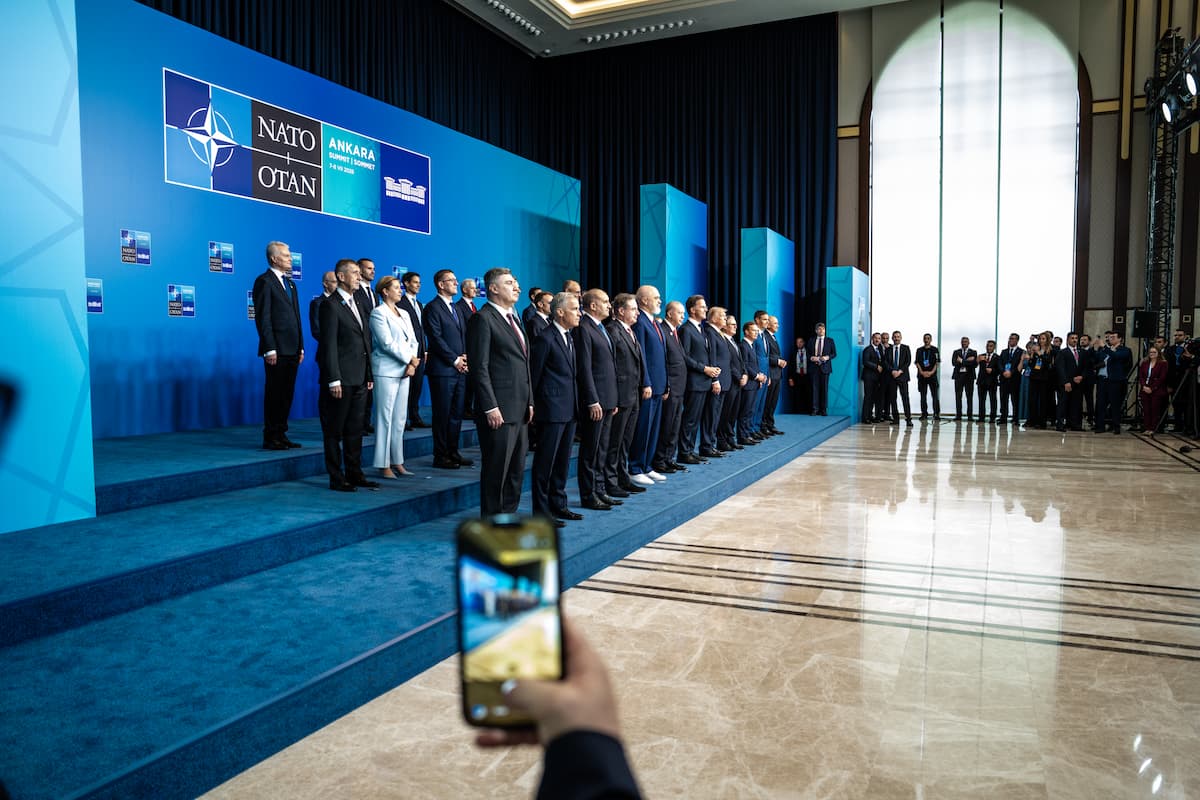
NATO’s July 7–8 summit in Ankara produced two industry-facing documents that get discussed as though they were one. The Ankara Summit Declaration set a procurement floor of more than $50 billion in new capability deals, which this publication has already shown is assembled from announcements sitting at very different stages of contractual maturity, from scheduled deliveries under old orders to a letter of intent with no fleet size attached.
A second document, released a day later and covering entirely different ground, has drawn far less scrutiny. The Strategy for Industry-NATO Cooperation, known as SYNC, endorsed by Allied leaders on July 8, 2026, is the Alliance’s first rewrite of its industry-engagement framework since 2013. Industry’s own trade body treats it, in the same breath, as part of the machinery behind coordinated procurement and long-term contracts. Read in full, the strategy does not describe itself that way. It calls itself voluntary, says it carries no direct funding or legal effect, and states that its measures focus on the pre-competitive phase of capability development, the stage before a contract rather than the stage of one. The agency that actually negotiates and signs the joint-procurement deals announced at the NATO Summit Defence Industry Forum, NSDIF26, is untouched by SYNC and, on NATO’s own account, is a pre-existing part of the NATO Enterprise rather than something the strategy creates.
- Endorsed
- July 8, 2026, by Allied Heads of State and Government, Ankara
- Length
- Introduction, Aim and Context, Scope, three Strategic Objectives, Way Ahead, two Appendices
- Stated legal and funding effect
- “No direct funding implications or legal impact”, Appendix 1, principle 2
- Supersedes
- 2013 Framework for NATO-Industry Engagement
- Next deliverable
- Implementation Plan, due by October 2026, drafted by the CNAD
What the strategy says about itself
SYNC organizes its content around three strategic objectives: enhanced communication and collaboration with industry, advancing innovation and interoperability, and strengthening, scaling and sustaining defence production. Under the first objective, NATO establishes a new engagement platform, the NATO Front Door for Industry, meant to aggregate information from existing NATO Enterprise procurement portals. As a separate measure under the same objective, NATO commits to releasing an unclassified version of its aggregated demand signal, drawn from the NATO Defence Planning Process; the strategy’s text does not state that this demand signal is hosted on or distributed through the Front Door specifically, although NATO’s live Front Door pages now carry a Demand Signal section. Under the second, NATO launches the NATO Engine, a network pairing manufacturers with idle production capacity to companies, particularly non-traditional suppliers, that need facilities to scale, under what the text calls a contractor- or factory-for-hire model. Under the third, Allies and NATO commit to examining options for surge production, strategic stockpiles and continuously running manufacturing capacity, and to running table-top exercises that stress-test production under crisis conditions.
None of that is framed as a change to how a contract gets negotiated or signed. The document is explicit about where its own remit ends. Its scope section states that in the competitive phase, individual Allies and the NATO Enterprise already have clear procurement pathways and established rules and procedures, and that the strategy’s measures address cooperation across the capability lifecycle with a focus on the pre-competitive phases. Appendix 1, which sets out the strategy’s governing principles, adds two qualifiers that matter more than any of the three strategic objectives: participation is voluntary, and the strategy has no direct funding implications or legal impact. A further principle, compliance with existing procurement and security rules, states that NATO’s current financial rules governing procurement continue to apply unchanged. Those are the Procurement Policy for NATO Common Funding and the Procedure for NATO Competitive Procurement, both approved by the North Atlantic Council on July 22, 2025, roughly a year before SYNC.
The mechanism that predates the strategy
Among the committees and agencies listed in SYNC’s own Appendix 2 are the bodies that already do the work of turning a capability requirement into a contract, and none is described as something the strategy creates. The same appendix also catalogues what SYNC does introduce, including the Front Door and the NATO Engine, the latter as part of a broader NATO Innovation Scale-Up Package. The NATO Support and Procurement Agency is described there as the Alliance’s lead organization for multinational acquisition, tasked with linking national requirements to industrial capacity and consolidating demand so registered suppliers can bid. NAHEMA, NAPMA and NETMA manage the NH90 helicopter, AEW&C and Eurofighter/Tornado programs respectively. SYNC’s own text treats all four as pre-existing parts of the NATO Enterprise rather than as new bodies it is standing up. SYNC itself gives no founding dates, but NSPA has operated since 1958, sixty-eight years before the strategy that describes it. SYNC’s contribution sits upstream of them: it changes how early and how broadly industry is consulted and informed, not who signs what once a program reaches the competitive phase.
That separation is not a rhetorical nuance. It is the difference between the two things NSDIF26 produced in the same week: an engagement strategy with no funding or legal force, and a set of procurement announcements whose contractual status still has to be worked out agency by agency, deal by deal.
| New from SYNC, July 8, 2026 | Unchanged, predates SYNC |
|---|---|
| NATO Front Door for Industry, an engagement and procurement-portal aggregator, to be built out iteratively | NSPA, multinational acquisition and procurement agency, operating since 1958 |
| NATO Engine, a capacity-matching network for manufacturers and non-traditional suppliers | Procurement Policy for NATO Common Funding; Procedure for NATO Competitive Procurement |
| Unclassified Innovation Demand Signal, a public-facing version of the NDPP demand signal | National procurement rules of individual Allies, which SYNC’s own principle keeps as the approval route for new engagement |
| CNAD Implementation Plan, due October 2026, not yet published | NAHEMA, NAPMA and NETMA, program-specific management agencies |
The GlobalEye case
The clearest illustration is the one capability program NATO chose to headline at NSDIF26. On July 7, 2026, NATO announced that 11 Allies, among them Belgium, Canada, Denmark, Germany, Latvia, Lithuania, Luxembourg, the Netherlands, Norway, Romania and Sweden, had agreed to the joint procurement of Saab GlobalEye aircraft as the Alliance’s new airborne early warning platform, replacing part of the aging Boeing E-3 fleet. NATO’s own language calls this a “joint procurement,” not a signed contract, and its announcement does not give an aircraft count. A figure of up to ten aircraft appears elsewhere, in Secretary General Mark Rutte’s remarks at the forum as reported by Breaking Defense, and independently in a Brussels trade-press account of the summit, but not in NATO’s own news item.
This publication’s earlier examination of the summit’s procurement figure reported that Saab confirmed no signed contract and no firm order existed as of late August 2026, and that agency-level negotiations were only beginning, specifically with NSPA, the same agency SYNC’s Appendix 2 describes and whose established rules SYNC leaves in place. In other words, the joint-procurement language used at NSDIF26 describes an agreement among 11 governments to proceed together; the contract that would make it binding runs through a channel SYNC does not touch and did not create.
How industry itself blurs the line
The Aerospace, Security and Defence Industries Association of Europe, reacting to the summit, welcomed the announced deals and then, in adjacent paragraphs, argued that coordinated procurement, pooled demand and long-term contracts are essential to expanding capacity, before noting that SYNC, supported by the Front Door and NATO Engine, is aimed at strengthening industrial cooperation and accelerating capability delivery. The statement does not claim SYNC creates the contracts; it sets the strategy and the procurement outcomes side by side, with only an “also notes” to mark that they are different things. Trade coverage of the summit followed the same pattern: one Brussels-based outlet treated the Summit Declaration, SYNC and the contracts announced at the forum as a single story about NATO becoming, in its own words, “the architect of a defence ecosystem,” rather than as three documents with three different legal statuses.
None of this makes the associations’ enthusiasm wrong. Pre-competitive engagement, a public demand signal and a capacity-matching network are things a supplier can reasonably welcome. But treating SYNC as the plumbing that turns Ankara’s announcements into contracts credits a voluntary, non-binding engagement strategy with an effect its own text disclaims.
What to watch
Reading the two documents separately
Nothing in SYNC is false, and nothing in the procurement announcements is inconsistent with it. What the week in Ankara produced is a strategy that reorganizes how NATO talks to industry before a competition starts, released in parallel with a set of capability announcements whose path to contract runs through mechanisms SYNC neither created nor modified. The distance between an announced joint procurement and a signed contract was already the subject of this publication’s earlier reporting on the summit’s headline figures. SYNC does not close that distance. By its own terms, it was not built to.
Sources
Primary and official documents
- NATO — Strategy for Industry-NATO Cooperation, official text, July 8, 2026, including Appendices 1 and 2 and the footnotes
- NATO — NATO releases new strategy for industry cooperation, July 8, 2026
- NATO — NATO’s new Airborne Warning and Control System is announced, July 7, 2026. This item lists the 11 participating Allies and uses the phrase “joint procurement”; it states no aircraft count
- NATO — Overview, 2026 NATO Summit in Ankara
- NATO — NATO Allies agree new procurement policy, July 22, 2025, for the adoption date of the two procurement documents SYNC’s Appendix 1 cites without a date
- NATO — NATO Front Door for Industry, the live platform, including its Demand Signal section
Trade press and analysis
- Aerospace, Security and Defence Industries Association of Europe — Statement on 2026 NATO Summit Defence Industry Forum announcements. The page carries no visible publication date; only the July 7, 2026 event date appears in the statement’s own text
- fw-mag — NATO tries to appear alive and well and wants to become a defence market architect, Caterina Tani, July 9, 2026, for the independent ten-aircraft figure and the “architect of a defence ecosystem” framing
Related coverage
- Ankara’s €70bn Ukraine pledge vs a €2bn-a-month run rate, August 27, 2026, for the composition of the $50 billion figure, Saab’s confirmation that no GlobalEye contract had been signed, the Rutte remark as reported by Breaking Defense, and the E-7A Wedgetail precedent