General Atomics Aeronautical Systems has added a dedicated strike version to its Gambit series of autonomous combat drones, unveiling Gambit 6 at the International Fighter Conference in Rome on 4 November 2025. The new variant brings a strongly air-to-surface focused configuration to a family that previously concentrated on sensing, air combat, training, reconnaissance and carrier operations. Company statements set a target of 2027 for the first export airframes, with European-specific configurations planned from 2029 and aligned with emerging loyal wingman requirements across NATO air forces.
Gambit 6 is presented as a collaborative combat aircraft able to fly with fourth- and fifth-generation fighters or operate in mixed formations with other drones. It adds air-to-ground strike, suppression of enemy air defenses and electronic warfare to a design lineage that already covers air-to-air missions through the YFQ-42A prototype in the U.S. Air Force’s CCA Increment 1 program. The air vehicle keeps the same broad outer lines as the earlier air-to-air Gambit configuration but receives mission systems tuned for “looking down” at ground and surface targets rather than focusing on aerial opponents.
Gambit 6 Strike Variant Design And Air To Surface Role
Conference material in Rome described Gambit 6 as a multirole unmanned combat aircraft with emphasis on precision attack against defended targets on land and at sea. Company descriptions list intended roles that include suppression and destruction of enemy air defenses, deep precision strike and electronic attack in contested airspace. A signature-reduced internal weapons bay and low observable shaping around the nose and inlets are intended to improve survivability near modern surface-to-air missile systems.
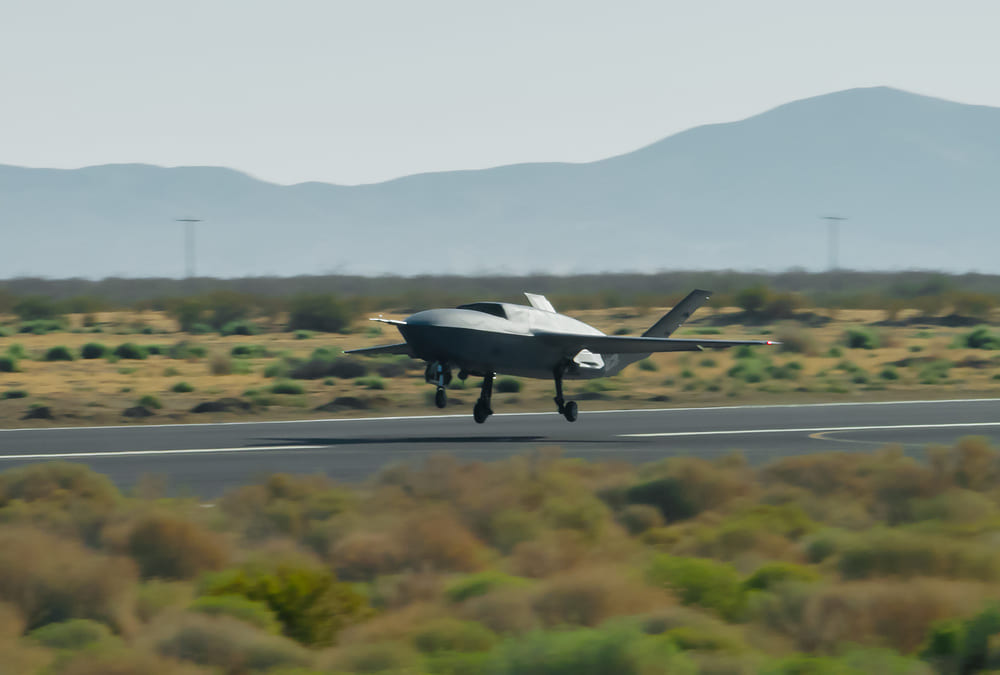
Artist’s impressions show a single-engine jet drone with a central dorsal intake, cranked delta wing and twin canted tails, closely matching the form already seen on the YFQ-42A CCA prototype. One rendering depicts a formation of Gambit 6 aircraft releasing multiple GBU-53/B StormBreaker precision glide bombs against coastal and maritime targets, which points toward carriage of small-diameter, network-enabled munitions inside the weapons bay. Company officials have not confirmed a specific weapons list, but available material indicates compatibility with current Western stand-off and SEAD/DEAD payloads in roughly the 100–250 kilogram class.
“These are real threats, and they require real solutions,” company president David R. Alexander said when announcing the aircraft, stressing the value of a modular internal bay for autonomy packages, sensors and weapons. The same airframe is expected to accept different payload sets, from compact jammers to strike weapons or cooperative “launched effects” drones, with reconfiguration carried out at unit level instead of lengthy depot work.
Gambit 6 uses open-architecture avionics and “pluggable” mission modules. Automation handles routine navigation and formation flying, while crews in lead fighters or ground stations retain authority over weapons release and major mission changes. According to defense officials, this matches current U.S. and allied practice for loyal wingman aircraft, which expect autonomous jets to maneuver, reposition and manage sensors without constant inputs from pilots already managing their own aircraft and the wider mission.
Sensors include radio-frequency receivers to locate hostile radars, electro-optical and infrared systems for target recognition and secure data links to pass targeting information to crewed aircraft. In the SEAD/DEAD role, Gambit 6 can fly ahead of fighters, detect emitters and either employ its own weapons or cue other shooters. Maritime strike configurations can carry seeker-equipped glide weapons for use against surface combatants while launch platforms remain outside overlapping shipborne and coastal missile coverage.
Modular Gambit Drone Family And CCA Program Connections
The Gambit program uses a common “Gambit Core” that groups landing gear, baseline avionics, fuel and power systems and much of the primary structure into a standard chassis. Company figures put this shared portion at about seventy percent of each airframe’s hardware cost, leaving a smaller fraction for variant-specific wings, fuselage changes and mission equipment. The approach simplifies production, training and support across a family that now covers six roles.
Gambit 1 is described as a long-endurance intelligence, surveillance and reconnaissance aircraft with high-aspect wings for long on-station times. Gambit 2 concentrates on air-to-air combat with provision for missiles. Gambit 3 serves mainly as a complex training adversary, while flying-wing Gambit 4 focuses on stealth reconnaissance. Gambit 5 introduces a carrier-capable configuration tied to the company’s wider uncrewed naval aviation work, with catapult launch and arrested recovery from large deck ships.
The series links to the XQ-67A Off-Board Sensing Station demonstrator, which flew in early 2024 under an Air Force Research Laboratory program. That aircraft introduced the “genus-species” idea, using a standard jet chassis to support multiple mission “species” with different outer wings and noses. General Atomics and U.S. officials describe XQ-67A as the starting point for the production-representative YFQ-42A CCA prototype, and company literature later aligned Gambit 1 with this sensing role.
YFQ-42A now serves as one of two competitive aircraft in the U.S. Air Force’s CCA Increment 1 program, alongside Anduril’s YFQ-44A. The YFQ-42A conducted its first flight on 27 August 2025, and General Atomics confirmed a second example in the air by early November. Officials confirm that Increment 1 focuses on air-to-air missions, with the CCA acting as a semi-autonomous escort and weapons carrier for aircraft such as the F-22 and F-35. Work already underway on its autonomy core, flight control laws and production tooling provides the technical base for the Gambit 6 strike configuration.
According to company statements, Gambit 6 airframes will enter the same industrial system as the CCA prototypes and the jet-powered MQ-20 Avenger, using facilities in Poway, California. The shared core lets General Atomics combine CCA production for U.S. services with export-focused Gambit variants on common lines, while buyers still specify national sensors, weapons and communications fits.
European Demand For Air To Ground Collaborative Combat Aircraft
European air forces have pushed loyal wingman concepts over the last two years, with Germany now the most visible example. Berlin is working toward a requirement for roughly four hundred advanced combat drones by 2029, bridging the gap until a future manned fighter under the Franco-German-Spanish program enters service. Planning documents and public comments from German officials describe a mix of reconnaissance, strike and electronic attack roles that match Gambit 6’s intended mission set.
Several European industry teams seek this market. Airbus has promoted its Wingman concept as an escort for Eurofighter Typhoon and partnered with Kratos to offer XQ-58A-based systems to the German Air Force, aiming at combat-ready drones around 2029. Other European and U.S. firms keep parallel proposals on the table, but most remain in concept or early prototype stages without fixed export schedules.
General Atomics plans to offer standard Gambit 6 airframes to international customers from 2027, with European “missionized” versions from 2029. The company has committed publicly to building industrial partnerships across Europe to deliver sovereign capabilities, a signal of readiness for local assembly, integration of national weapons and sensors and shared responsibility over mission data. According to industry sources, exploratory talks already involve possible partners in Germany, Italy and other NATO air forces that want fielded CCAs without waiting for entirely new domestic designs.
European concepts for autonomous aircraft assign high priority to suppressing air defenses and striking deep targets in the opening stages of high-intensity conflict. Gambit 6’s internal bay and low observable geometry support operations inside dense radar coverage, either in mixed packages with crewed fighters or as stand-in strikers guided from standoff command aircraft. The same configuration suits maritime operations in the North Atlantic and Mediterranean, where coastal and naval targets require precision attack while manned aircraft remain outside overlapping missile envelopes.
Gambit 6’s open-architecture avionics and modular payloads give room for national datalink standards and encryption, which will influence export approvals as much as aerodynamic performance. European studies on CCA employment describe remotely-piloted and autonomous aircraft feeding targeting and electronic order of battle data directly into alliance air operations centers, and operators want new systems that connect cleanly with those networks.
United States Programs And Competing Loyal Wingman Platforms
The Air Force CCA effort has already down-selected the General Atomics YFQ-42A and Anduril YFQ-44A Fury as Increment 1 competitors, with flight testing under way for both aircraft and a selection decision expected in 2026. Follow-on production contracts are intended to deliver a first operational CCA increment before the end of the decade, then expand the fleet for different mission sets.
GA-ASI describes the YFQ-42A as optimized for air-to-air work with an autonomy core trained through extensive MQ-20 Avenger flight hours. The company has highlighted several years of test campaigns that used Avenger as a surrogate to refine collaborative behaviors, formation control and autonomous sensor management. That software investment and the genus-species hardware approach proven with XQ-67A feed into production designs such as Gambit 6, which reuse the same digital models, manufacturing techniques and control logic.
The U.S. Navy has added its own demand. In October 2025 the service contracted General Atomics to develop conceptual designs for a carrier-capable CCA to join future carrier air wings. Public information states that the Navy wants a modular aircraft that can shift between missions while operating from catapults and arresting gear. Company comments indicate that the proposal draws on Gambit-family jets, with carrier-oriented work associated with Gambit 5 expected to guide that design.
Parallel U.S. efforts with other manufacturers broaden the CCA field. The Marine Corps has advanced the Kratos XQ-58 Valkyrie toward program-of-record status and continues test flights to explore electronic warfare and manned-unmanned teaming with F-35B aircraft. Exercises have already shown XQ-58 working in cooperative kill chains with crewed fighters. Other firms, including Lockheed Martin with its Vectis concept, Shield AI with X-BAT, Boeing with the MQ-28 Ghost Bat and Northrop Grumman with the Project Talon wingman design, are pushing their own large CCA-type aircraft, so Gambit 6 enters a crowd of competing offers.
Outside the U.S. and its closest allies, China is moving fast with uncrewed combat aircraft. Recent imagery shows the stealthy GJ-11 flying operationally with J-20 and J-16D aircraft, while the 2025 parade in Beijing included several large unmanned systems described as future loyal wingmen and CCA-type drones. According to officials, this activity reinforces the pressure on Western air forces to field their own autonomous combat systems on firm timelines.
According to industry sources, General Atomics presents Gambit 6 as a reusable strike aircraft that complements CCA prototypes already ordered by U.S. services rather than as a disposable asset. The company stresses commonality with YFQ-42A and the wider Gambit family, noting that shared logistics, training and mission software will influence buyer choices when they evaluate fleets of dozens or hundreds of drones. Export-focused customers in Europe and elsewhere are watching U.S. flight test data closely, since issues discovered in the CCA program are likely to affect later Gambit production as well.
Our analysis is that Gambit 6 now anchors the strike end of the Gambit series and gives General Atomics a defined export offer for air-to-surface CCA roles, while YFQ-42A covers U.S. air-to-air requirements and carrier-oriented work develops under Navy contracts. The design combines an announced delivery window, visible links to a flying U.S. prototype and a modular architecture already shown in trials, which together give it a clear position in a fast-crowding market for autonomous combat aircraft.
REFERENCE SOURCES
- https://www.ga-asi.com/new-ga-asi-gambit-6-ucav-adds-air-to-ground-operations-for-international-cca
- https://www.ga-asi.com/remotely-piloted-aircraft/gambit-series
- https://www.ga-asi.com/ga-asi-marks-another-aviation-first-with-yfq-42a-cca-flight-testing
- https://www.af.mil/News/Article-Display/Article/4171208/daf-begins-ground-testing-for-collaborative-combat-aircraft-selects-beale-afb-a
- https://www.airandspaceforces.com/general-atomics-flies-second-cca-ground-attack-gambit
- https://breakingdefense.com/2025/11/general-atomics-launches-gambit-6-drone-wingman-for-air-to-ground-operations
- https://www.janes.com/osint-insights/defence-news/air/ifc-2025-ga-asi-reveals-gambit-6-cca-for-air-to-surface-operations
- https://www.fw-mag.com/shownews/799/general-atomics-presents-gambit-6-cca-for-air-to-ground-operations
- https://www.armyrecognition.com/news/aerospace-news/2025/general-atomics-gambit-6-drone-hints-at-how-future-wars-could-be-fought-with-fewer-pilots
- https://aerospaceglobalnews.com/news/germany-combat-drones-2029
- https://www.airbus.com/en/newsroom/press-releases/2024-06-unmanned-escort-for-manned-fighter-jets-airbus-presents-new-wingman
- https://breakingdefense.com/2025/07/airbus-kratos-team-to-pitch-german-air-force-drone-wingmen
- https://www.airandspaceforces.com/xq-67-first-flight-afrl-cca
- https://www.ga-asi.com/ga-asi-selected-to-support-us-navy-cca-design-effort
- https://news.lockheedmartin.com/2025-09-21-Lockheed-Martin-Vectis-TM-Best-in-CCA-Class-Survivability
- https://shield.ai/shield-ai-unveils-x-bat-an-ai-piloted-vtol-fighter-jet-for-contested-environments
- https://www.boeing.com.au/products-services/defence-space-security/ghost-bat
- https://breakingdefense.com/2025/12/project-talon-northrop-unveils-new-loyal-wingman-drone-design
- https://www.marinecorpstimes.com/news/your-marine-corps/2025/08/13/new-autonomous-aircraft-in-development-for-marines
- https://www.twz.com/air/more-mq-58-variants-in-the-works-after-marines-move-to-make-valkyrie-a-full-program-of-record
- https://theaviationist.com/2025/11/11/gj-11-ucav-flying-with-j-20-j-16
- https://insideunmannedsystems.com/china-reveals-large-new-stealth-fighter-drones-alongside-collaborative-combat-aircraft