Korea Investment Week in Seoul ran from Sept. 9 to 12 and produced shipbuilding announcements with direct bearing on U.S. yards and Navy sustainment. Hanwha confirmed a multibillion-dollar expansion at its Philadelphia yard and outlined a Busan-centered maintenance program for U.S. naval vessels. HD Hyundai detailed new work at Subic Bay and proceeded with a corporate merger that aligns its naval unit for U.S. contracts. Samsung Heavy Industries entered a formal partnership with a U.S. repair prime to add forward-deployed capacity in the Indo-Pacific. According to industry sources, these moves fold into the broader “MASGA” framework that Korean and U.S. officials have discussed since late summer.
Hanwha Philly Shipyard $5 Billion Investment and Busan MRO Cluster
Hanwha set the pace on capital commitments at the end of August with a $5 billion infrastructure program at Hanwha Philly Shipyard. The package covers new docks and quays, heavier lift, and block-assembly capability sized for higher throughput. Company materials point to a goal of lifting output from fewer than two vessels per year to a double-digit cadence once new facilities come online. State and city offices in Pennsylvania acknowledged the expansion and described parallel workforce steps. Defense officials confirm the Navy tracked the announcement due to the added East Coast capacity intersecting with sealift recapitalization and auxiliary construction planning.
The Philadelphia program intersects with orders outside of defense. Hanwha has highlighted LNG and commercial tonnage opportunities to keep lines hot between government blocks. According to industry sources, shipyard planners in Philadelphia have already sketched new lay-down areas, a longer drydock plan and utility corridors sized for heavier prefabrication. The machinery footprint grows accordingly: plate shops, panel lines, and a larger blast-and-paint facility.
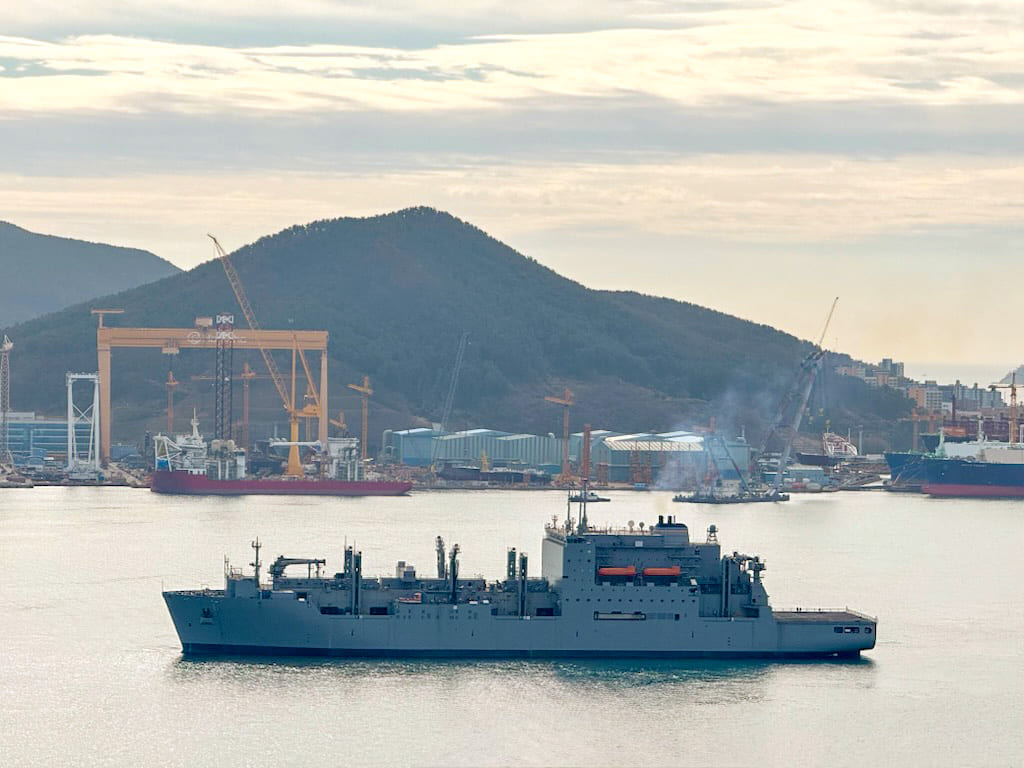
Hanwha coupled the U.S. buildout with a service hub in Busan. The company’s special ship planning lead, Choi Jeong-hoon, briefed reporters in Seoul on a plan to aggregate more than 1,000 regional suppliers and run a specialized cluster that can turn maintenance, repair and overhaul work for roughly 11 U.S. Navy vessels per year. The company already completed a full regular overhaul on USNS Wally Schirra in Korea earlier this year, the first of that size for a Military Sealift Command ship at a Korean yard. Navy public affairs documents recorded a seven-month period for that overhaul.
Hanwha’s message at Korea Investment Week separated production and sustainment: Philadelphia for newbuilds, Busan for periodic maintenance that fits the West Pacific operating pattern. Program officers familiar with sealift and auxiliaries see one immediate use case: scheduled availabilities that would otherwise stack at Pearl Harbor, Japan or West Coast yards.
Workforce sits at the center of the Philadelphia plan. The yard will need more welders, fitters, electricians and planners than the current headcount can furnish. Local government releases referenced a joint task force to streamline permits and coordinate training cohorts with area schools. According to industry sources, Hanwha’s U.S. recruiting teams began outreach before the August ceremony. Korean foremen and planners would backstop early phases on site while unions and trade schools fill gaps, subject to U.S. labor rules.
HD Hyundai Subic Bay Shipyard and Merger with Mipo
HD Korea Shipbuilding & Offshore Engineering marked a steel-cutting in Subic Bay on Sept. 2. The Philippines site had gone quiet years ago under prior owners and then changed hands to U.S. investors. HD Hyundai now leases part of the complex and has reactivated it. The first hull under the renewed operation is a petrochemical carrier from a four-ship series ordered late last year. The company also flagged the site for naval MRO and patrol craft sustainment through existing links with the Philippine Navy. Subic sits on well-traveled routes and can stage components and labor closer to Western Pacific demand than Korean yards can during peaks.
HD Hyundai announced a merger plan between HD Hyundai Heavy Industries and HD Hyundai Mipo in late August, with completion scheduled for December subject to normal approvals. The transaction aligns naval and special ship capacity with a mid-sized yard that has useful docks and a proven workforce. Internal messaging in Ulsan pointed to U.S. naval work as a long-term target once legal gates allow. The plan centers on warship types the company already builds-destroyers, frigates and auxiliaries-translated into American programs through licensed production or U.S. subsidiary builds.
At Korea Investment Week, HD executives added details on Subic Bay’s military utility. Jang Gwang-pil outlined an MRO base plan aimed at frigates and patrol craft, with tooling that mirrors what the company uses at home for navy work. Defense officials confirm that U.S. teams have walked the site and compared safety, lifting plans and quality systems against Navy checklists used at allied yards in Japan and Singapore.
U.S. statutes, including the Jones Act and the Byrnes-Tollefson Amendment, constrain foreign builds for Navy programs. Reuters interviews with Hyundai executives in mid-September included a clear acknowledgment of those rules and the need to work through U.S. ownership and build requirements. The merger with Mipo helps from an execution angle because it balances dock space across several campuses and concentrates experience in outfitting combatants.
Samsung Heavy Industries and Vigor Marine Partnership
Samsung Heavy Industries and Vigor Marine Group announced a strategic partnership on Aug. 26. The text lays out forward-deployed maintenance, repair and overhaul options for the U.S. Navy and Military Sealift Command in the Indo-Pacific. Vigor brings U.S. prime credentials and an existing footprint across several American locations. Samsung contributes engineering depth, disciplined production methods and access to high-capacity shops in Korea when component fabrication or heavy machining outstrips U.S. availability.
The release also leaves a door open for joint support to U.S. shipbuilding. Vigor has past experience in construction as well as repair. Samsung knows high-volume modular assembly and digital yard control. According to industry sources, the pair has already exchanged process maps for planning systems, welding procedures and inspection packages.
This partnership enters into a Navy maintenance picture that still shows gaps. MSC and surface combatant availabilities continue to bunch on the West Coast and Hawaii. A forward MRO option in allied territory reduces shuttle time for certain classes and keeps crews closer to patrol lines. A repair team that can pull shaft work, hull steel and habitability upgrades in theater with U.S. oversight trims days.
MASGA Framework and Legal Gates
Coverage across September and early October described MASGA in concrete terms: a Korean offer of large-scale capital, project management and production discipline aimed at American yards; U.S. interest tied to backlog relief and newbuild schedules; and a need to align laws and visas with the flow of work. Breaking Defense outlined the policy pieces under review last week, including options to adjust visa pathways for specialized trades, to streamline temporary duty for planners and engineers, and to align U.S. rules that govern where and how Navy work can occur.
Reuters reporting in mid-September captured another point: U.S. market share in commercial newbuilds sat at a fraction of one percent last year, while Korea and China accounted for the vast majority. That imbalance helps explain why Korean firms see room to invest in U.S. facilities.
Korea Investment Week sessions made one shift clear. Company officials stopped speaking in generalities and attached numbers to output, docks, vessels per year and supplier counts. Hanwha gave the Busan cluster an annual vessel target. HD Hyundai attached a merger date and a public steel-cutting in Subic. Samsung and Vigor issued a U.S.-prime foreign OEM partnership statement with stated objectives in the Indo-Pacific.
Labor and community reactions entered the record as well. Korean press accounts from early September described union concerns around the Hyundai merger and its effect on job security at home. U.S. local coverage around the Philadelphia Navy Yard focused on training, wages and the city’s role in clearing permits.
Defense officials confirm the Navy remains focused on compliance in any overseas work. That means clear lines on what kinds of jobs can move to allied yards and what inspection regimes apply. The Wally Schirra overhaul offered a reference package: a defined scope, U.S. oversight, parts traceability and schedule performance that a Western Pacific yard can repeat.
Procurement rules around warship construction are tighter. The Byrnes-Tollefson language sets a high bar for where Navy hulls can be built. That pushes Korean builders toward U.S. soil for any future combatant production, handled by U.S. subsidiaries that meet ownership and control tests.
REFERENCE SOURCES
- https://www.defensenews.com/industry/2025/09/16/south-korean-manufacturers-outline-plans-to-bolster-us-shipbuilding/
- https://www.navytimes.com/industry/2025/09/16/south-korean-manufacturers-outline-plans-to-bolster-us-shipbuilding/
- https://www.navy.mil/Press-Office/News-Stories/Article/4118860/usns-wally-schirra-completes-major-maintenance-at-south-korean-shipyard/
- https://www.kedglobal.com/kiw-2025/newsView/ked202509150011
- https://www.vigormarine.com/news-press/samsung-vmg
- https://news.usni.org/2025/08/27/south-korean-shipbuilder-to-invest-5b-in-philadelphia-shipyard
- https://breakingdefense.com/2025/10/the-us-rok-test-case-can-visas-and-rules-unlock-american-shipbuilding/
- https://www.reuters.com/markets/emerging/south-korean-shipbuilder-hd-hyundai-heavy-merge-with-affiliate-hd-hyundai-mipo-2025-08-27/
- https://www.reuters.com/world/asia-pacific/south-koreas-hd-hyundai-heavy-talks-buy-us-shipyard-2025-09-18/
- https://www.hd.com/en/newsroom/media-hub/press/view?detailsKey=3645
- https://www.koreaherald.com/article/10557101
- https://biz.chosun.com/en/en-industry/2025/09/15/NRM3EEBWVFESRDVGE6FWQKKOHQ/
- https://dced.pa.gov/newsroom/icymi-governor-shapiro-and-secretary-siger-join-republic-of-korea-president-lee-to-highlight-strategic-investments-in-the-philadelphia-navy-yard-to-create-jobs-and-dramatically-expand-shipbuilding/