
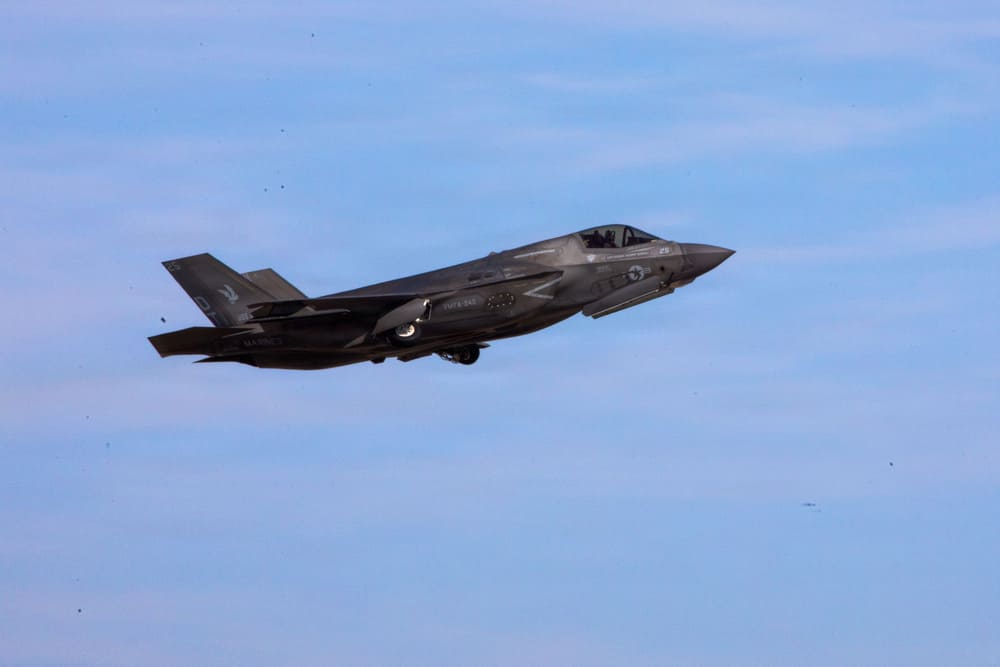
HMS Prince of Wales has completed her Mediterranean work-up with 24 British F-35B Lightning II jets embarked, the largest number of the type yet fielded on a single ship and the biggest fifth-generation carrier air wing assembled by the United Kingdom. The deployment confirms a Queen Elizabeth-class carrier can sail with a full national F-35B air group, without outside squadrons filling the gap.
The full wing came together after Carrier Strike Group 25 moved from its Indo-Pacific phase under Operation Highmast into Italian-led Exercise Falcon Strike in the central and eastern Mediterranean. Defense officials say the November serials gave NATO the final evidence it needed for Full Operating Capability of UK Carrier Strike under alliance command. Six F-35Bs joined Prince of Wales after she returned to the Mediterranean at the end of October, flying from RAF Marham and bringing the total on board to 24. Earlier in the eight-month cruise, a smaller Lightning detachment had already flown live Paveway IV missions and long-range tasking in the Indian Ocean and Pacific before the group turned back toward Europe.
The Royal Navy describes the embarkation as the highest number of UK F-35Bs yet loaded on a Queen Elizabeth-class carrier, reached after months of near-continuous operations east of Suez. According to industry sources, it also marks the largest fifth-generation air wing deployed at sea so far, overtaking the United States Marine Corps “Lightning carrier” proof-of-concept on USS Tripoli, which sailed with 20 F-35Bs in 2022.
Exercise Falcon Strike Puts 24 UK F-35Bs on HMS Prince of Wales
The 24 embarked Lightnings came from 617 Squadron RAF, 809 Naval Air Squadron and 207 Squadron RAF. The Operational Conversion Unit supplied new pilots to the frontline force. The air group included experienced crews for high-end missions, instructors and younger pilots on their first long deployment from a carrier. The Navy says this is the largest British fast-jet air group to sail on a UK carrier since the end of the Cold War and the first time an all-British F-35B deckload reached this size.
Exercise Falcon Strike is led by the Italian Navy and Air Force and uses joint air and maritime scenarios over the central Mediterranean. British F-35Bs flew combined missions with Italian F-35A and F-35B jets, along with French, Greek and United States aircraft, in day and night serials. According to officials involved in planning, the missions focused on defending the carrier group against air and missile threats and striking maritime and coastal targets in a dense electronic-warfare environment.
Commodore James Blackmore, commander of the UK Carrier Strike Group, called Falcon Strike “a real demonstration of the warfighting readiness” of the formation and pointed to high sortie rates and close coordination with Italian staffs. During one surge period late in the deployment, defense officials confirm the embarked Lightnings flew 36 sorties in 24 hours, the most intense short-takeoff strike activity by UK fast jets from a ship in recent decades.
The air group aboard Prince of Wales extends beyond the Lightnings. Merlin HM2 helicopters from the carrier air wing provide anti-submarine cover and airborne early warning. Wildcats and uncrewed systems handle surface search, liaison flights and light logistics within the task group. The Navy has also used Operation Highmast to expand trials with Malloy T-150 heavy-lift drones, which now move spares and small loads between the carrier and escorts on a routine basis, according to naval officers on the deployment.
Specialists involved in Falcon Strike IT support say the exercise also served as a live test of UK and Italian methods for handling fifth-generation mission data and electronic-order-of-battle updates. The British side used the deployment window to cut the time needed to push new threat libraries and software loads to embarked F-35Bs over secure links. That work matters once more aircraft and more carriers enter regular NATO duty.
NATO Declares Full Operating Capability for UK Carrier Strike Group 25
CSG25 forms around Prince of Wales as flagship, with Type 45 destroyer HMS Dauntless providing area air defense and Type 23 frigate HMS Richmond focused on anti-submarine tasks. A Tide-class replenishment tanker and allied escorts, including Norwegian frigate HNoMS Roald Amundsen, rotated in and out of the screen during the Indo-Pacific and Mediterranean phases. A Royal Navy Astute-class attack submarine normally trails the group as its covert layer.
During the Mediterranean leg, NATO placed the British carrier group under allied operational control. The ship flew the NATO flag in Falcon Strike, and alliance staffs in Naples treated the British F-35Bs as part of a shared fifth-generation pool alongside Italian assets ashore. NATO evaluation teams observed the exercise to confirm the group could deliver sustained strike and air-defense operations at the level required for Full Operating Capability.
On 17 November 2025, the UK Ministry of Defence announced Carrier Strike had reached Full Operating Capability and been assigned as a standing NATO asset. Officials pointed to sustained sortie generation from the carrier, layered air and missile defense around the task group, and solid command links from the flagship into the wider alliance network.
Defence Secretary John Healey used a visit to Prince of Wales off Naples with Italian counterparts to mark the step. He stated that the carrier and her strike group “will drastically increase NATO’s lethality and readiness” and, for the first time, place a fully equipped fifth-generation carrier force directly under alliance command. After the Falcon Strike phase, CSG25 shifted into wider NATO activity including the Neptune Strike series of maritime drills. Allied planners now bracket Prince of Wales more closely with U.S. big-deck carriers within the same command chain, even though the British ship launches short-takeoff jets rather than catapult aircraft.
The deployment is scheduled to end with a homecoming in early December, closing an eight-month cruise that began in April and took the group through the Red Sea, Indian Ocean, Pacific and Mediterranean. Reports on the return say more than 2,500 personnel from the UK and partner navies served with the group at its peak and note the reception in Portsmouth will be the largest Royal Navy carrier homecoming in roughly twenty years.
United Kingdom F-35B Orders and Fleet Availability Limit Repeat Deployments
The ability to place 24 F-35Bs on one deck comes from a fleet that remains modest in size. The UK has ordered 48 F-35Bs in its first tranche, with deliveries continuing. The National Audit Office reported in mid-2025 that 38 aircraft had arrived by early that year, including test and training jets, and projected all 48 would be in service by 2026 after earlier delays. Government statements this year repeated the long-standing aim of buying 138 F-35s across the life of the programme.
Ministers confirmed in June that the planned second batch of 27 aircraft would include at least 12 F-35A conventional-takeoff jets alongside 15 more F-35Bs. The change restores a dedicated airborne nuclear role under NATO through the F-35A and eases some training pressure on the short-takeoff fleet, though it also limits how much the B-variant pool can grow. Open sources tracking the fleet, along with the acknowledged loss of one F-35B in a 2021 takeoff accident from HMS Queen Elizabeth, indicate the UK will have a usable pool in the low forties of flyable F-35Bs until tranche-two deliveries start.
The NAO report and subsequent Public Accounts Committee hearings underlined constraints beyond the headline fleet size. In 2024 the British F-35B fleet reached about half of the Ministry of Defence’s target mission-capable rate and roughly a third of the full-mission-capable rate. Maintenance delays, shortages of spare parts and corrosion from heavy maritime use all held availability down. Limited engineering manpower and slower than planned growth in the pool of trained pilots further reduced the number of jets ready for daily flying.
Committee members concluded that these problems left a gap between the number of aircraft on the books and the number ready for combat or advanced training at any given time. They pressed the Ministry for firmer plans to expand spares, deepen maintenance capacity and integrate more weapons, including stand-off missiles for strikes against defended targets from longer range. According to officials closely involved in planning, the decision to send 24 British F-35Bs to sea on Prince of Wales without a U.S. Marine Corps detachment underlines a choice to carry more of the carrier-strike burden inside the national fleet, despite those constraints.
Queen Elizabeth Class Carriers Move Toward Hybrid Air Wings and Assisted Launch Systems
The record F-35B deckload is part of a broader effort to change how the Queen Elizabeth class operates over the next decade. The 2025 Strategic Defence Review set an ambition for “hybrid carrier air wings” that combine F-35Bs with uncrewed systems and long-range missiles, so Carrier Strike can operate at greater reach without a matching increase in crewed fast-jet numbers. Project Ark Royal, under the Future Maritime Aviation Force programme, studies options to retrofit assisted launch and recovery equipment to both carriers. The work would let them operate larger uncrewed aircraft and possibly conventional-takeoff manned types later on.
Colonel Phil Kelly, Head of Carrier Strike and Maritime Aviation, outlined the concept in 2023 as a stepwise route “from STOVL to STOL, then to STOBAR and then to CATOBAR,” spreading cost and raising performance in stages. Trials already started. In late 2023 Prince of Wales hosted General Atomics’ Mojave short-takeoff drone and flew repeated sorties from the ski-jump without catapults or arrestor gear. During Operation Highmast, Malloy vertical-lift drones accumulated hours across the group and gave planners early evidence for heavier loyal-wingman-style aircraft and deck-launched surveillance systems later in the decade.
China has brought its electromagnetic-catapult carrier Fujian into service with J-35 stealth fighters and KJ-600 fixed-wing early-warning aircraft. Japan continues conversion of the Izumo class for regular F-35B operations. Within NATO, officials describe the British carrier group’s future role as pairing STOVL jets with uncrewed platforms rather than copying U.S. nuclear-powered carrier forces. Senior Royal Navy leaders also tie the hybrid air-wing effort to specific dates. First Sea Lord General Sir Gwyn Jenkins said earlier this year he wants to launch a jet-powered collaborative combat drone from a Queen Elizabeth-class carrier before the end of 2026, and Ministry planning for the next Indo-Pacific deployment in 2029 assumes some level of uncrewed combat air on board if current programmes hold.
Our analysis shows the present Prince of Wales cruise did more than produce a headline figure for embarked F-35Bs. It showed the UK can field a NATO-assigned carrier group with a nationally generated fifth-generation air wing, even though fleet growth, aircraft availability and the first steps toward a combined crewed and uncrewed carrier force still limit how often it can do it again.
REFERENCE SOURCES
- https://www.royalnavy.mod.uk/news/2025/november/06/20251106-highest-number-of-f35-jets-arrive-on-hms-prince-of-wales-for-nato-exercise
- https://www.navylookout.com/24-british-f-35-jets-now-embarked-on-hms-prince-of-wales/
- https://theaviationist.com/2025/11/06/hms-prince-of-wales-24-uk-f-35bs/
- https://www.twz.com/sea/british-carrier-hosts-largest-number-of-f-35bs-on-a-ship-ever
- https://www.royalnavy.mod.uk/news/2025/november/17/20251117-uk-carrier-strike-group-mission-ready-after-mediterranean-workout
- https://www.gov.uk/government/news/boost-to-warfighting-readiness-as-britains-aircraft-carrier-fully-mission-ready-and-committed-to-nato-for-the-first-time
- https://euro-sd.com/2025/11/major-news/47583/pow-embarks-24-f-35bs-in-med/
- https://euro-sd.com/2025/11/major-news/47843/foc-uk-carrier-strike-group/
- https://www.nao.org.uk/reports/the-uks-f-35-capability/
- https://www.navylookout.com/nao-report-confirms-uk-f-35-fleet-under-staffed-and-under-armed/
- https://en.wikipedia.org/wiki/Lockheed_Martin_F-35_Lightning_II_procurement
- https://en.wikipedia.org/wiki/HMS_Prince_of_Wales_(R09)
- https://www.twz.com/sea/royal-navy-to-arm-its-carriers-with-long-range-missiles
- https://www.navalnews.com/event-news/cne-2023/2023/06/uk-project-ark-royal-catapult-aircraft-carriers/
- https://www.navylookout.com/the-royal-navy-has-ambitious-plans-for-its-future-maritime-aviation-force/
- https://ukdefencejournal.org.uk/project-ark-royal-plans-for-angled-decks-and-drones/
- https://armyrecognition.com/news/navy-news/2025/chinas-fujian-carrier-makes-history-with-first-electromagnetic-launch-of-j-35-stealth-fighter
- https://www.reuters.com/world/china/china-begins-commissioning-fujian-aircraft-carrier-2025-11-07/