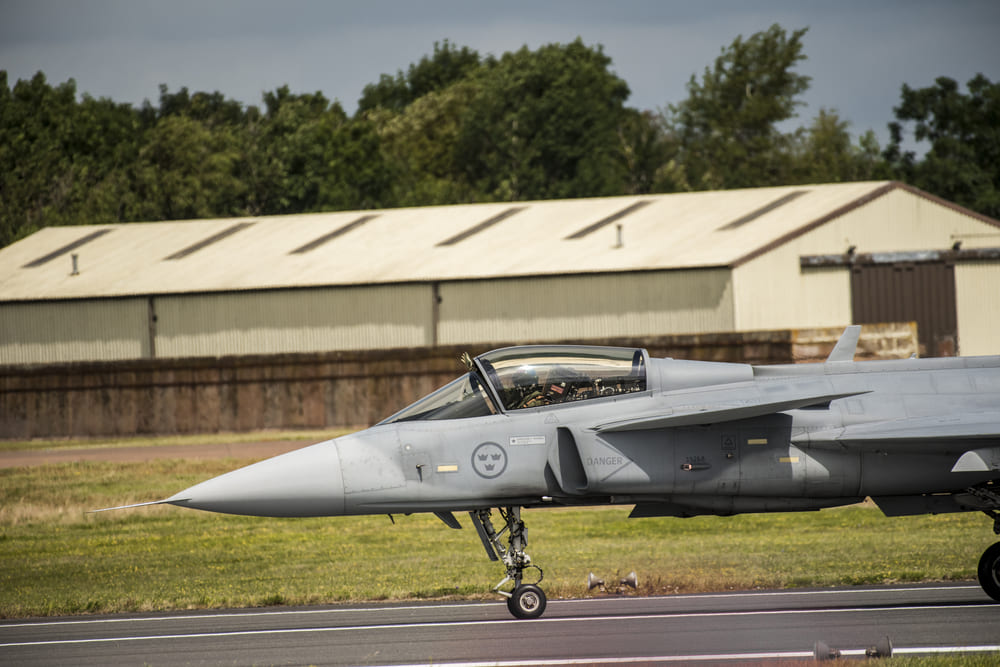
The first operational Gripen E fighters are now in Swedish Air Force service at F 7 Skaraborg Wing in Såtenäs. The formal introduction took place on Oct 20, 2025. The first two airframes carry registrations 609 and 610. Defense officials confirm the twin jets are the opening tranche from Sweden’s 60-aircraft order. Deliveries run through 2030.
Senior leaders from the Ministry of Defence, the Armed Forces, FMV, and industry attended the handover at Såtenäs. “The JAS 39 Gripen E is not just an upgrade of previous versions but in many respects a completely new aircraft type… built to meet future requirements for survivability, range, sensors and interoperability,” said Colonel Mattias Ottis, F 7 Wing commander. Sweden’s Commander-in-Chief General Michael Claesson added, “Gripen E strengthens our national defence capability to meet future threats together with allies.” Air Force chief Maj Gen Jonas Wikman called it “a platform that is tailored to our needs.”
The government presented the day as part of a wider reinforcement effort. An official account places the event on Oct 20 at F 7 and notes Sweden will induct 60 single-seat Gripen E fighters by 2030, in parallel with upgrades to the C/D fleet.
Gripen E Service Entry and Conversion at F 7 Såtenäs
Operational conversion and initial tactics work start at F 7, long tied to Gripen transitions. Ceremony imagery and service footage identified 609 and 610 as the first delivered examples. According to defense sources on site, the aircraft arrived configured for training and systems evaluation rather than quick deployment abroad. The Air Force will complete unit acceptance, slot the type into its training pipeline, and expand flying across seasons before assigning additional wings.
Stockholm’s official account underscores a deliberate rollout. The government states deliveries run from Oct 2025 to 2030 to build capacity in steps. Sweden keeps the existing C/D divisions on duty during the ramp. FMV says capability development on E proceeds in parallel with continued C/D upgrades. Both lines remain tactically relevant during the transition.
FMV’s head of aerospace, Carl-Fredrik Edström, said: “We will now continue to develop the system in parallel with the Gripen C/D, and at the same time continue to deliver Gripen E to the armed forces until 2030.” The statement matches the Air Force plan to field the E without a near-term gap.
Statements at Såtenäs set near-term priorities. Defense officials say the immediate focus is service entry, pilot and maintainer conversion, and building the mission data and tactics that exploit the E’s sensor and electronic warfare suite. Swedish Air Force planners did not publish a squadron-by-squadron induction plan. The program is set for continuous flow to 2030.
Gripen E Sensors, Weapons, EW and Performance vs Gripen C/D
Gripen E is a larger, longer-range derivative of the C/D powered by GE’s F414 and built on a new avionics architecture. The airframe has 10 external stations and more internal fuel than the C, which extends reach and payload flexibility without conformal tanks. Saab lists an AESA radar, the Skyward-G IRST, a modern comms suite, and an advanced EW system. These are baseline features.
Weapons cover Swedish and NATO stocks. The E integrates MBDA Meteor for beyond-visual-range shots and IRIS-T for high off-boresight engagements, plus precision-guided munitions and the RBS 15 anti-ship family. Meteor end-to-end firings from a Gripen E at Vidsel cleared a key step on the weapons plan.
The design supports heavy loadouts. Industry material and program reporting describe extremes such as nine air-to-air missiles, four RBS 15s for maritime strike, or 16 GBU-39 Small Diameter Bombs for deep precision attack when fuel carriage allows. The Swedish Air Force does not publish standard public loadouts. Even so, the hardware baseline and stores certification record support those load combinations.
A new cockpit and software stack change how crews manage the fight. A wide-area display, rehosted software, and faster data fusion bring radar, IRST, and EW inputs into a single picture to cut pilot workload. Gripen E keeps the short-strip turnarounds and dispersed basing requirement, which drives quick mission reprogramming and built-in tests on the ramp. Saab says this enables repeatable road sorties by small teams.
Electronic warfare is central on the E. The suite integrates threat warning, electronic support, and active jamming plus towed decoys and distributed missile warners for 360-degree coverage. Swedish services have not detailed podded versus internal configurations for initial operations, according to officials, but confirm EW remains a core element of employment.
Another strand advanced this year. Saab and Helsing flight-tested an air-combat AI agent, “Centaur,” on a Gripen E in late May and early June in real BVR setups against a human-flown adversary. The AI handled complex geometry and shot cues and briefly took tactical control during specific windows, with a pilot in the loop. The work falls under Sweden’s KFS future fighter studies and points toward crewed-uncrewed teaming later in the decade.
Parallel Operations With Gripen C/D and NATO Integration
Sweden will field the E alongside upgraded C/Ds for a relatively long period. The Air Force keeps six fighter divisions active as pilots and maintainers convert in blocks. The official plan runs to 2030, with E-series systems development and tactical testing moving in parallel. Routine QRA and Baltic approaches tasking continues through the transition.
NATO membership in March 2024 changed the setting. Sweden now aligns air policing and exercises under alliance frameworks. Planners value an E-series that fuses data over secure links with allied ISR, early warning, and fighters. Government notes and alliance releases this year reference highway operations, short-strip landing practice, and multinational air policing rotations as recurring threads.
Dispersed basing remains a Swedish signature. Gripen units train for road operations using small teams. Saab states a 10-minute air-to-air turnaround target using a six-person crew. The design supports operations from 500–600 meter straight roadway segments using internal power and modular gear. Gripen E keeps these traits and the service-friendly access approach.
There is no two-seat E for conversion in Sweden. The Air Force bought only single-seat Gripen E. Brazil’s program includes the two-seat F. The choice pushes more training into simulators and on-type instruction for crews moving from C/D. Officials say E handling is familiar enough to shorten the learning curve for experienced Gripen pilots.
FMV spending signals what comes next. In mid-October FMV awarded Saab a SEK 2.6 billion order to continue concept studies for Sweden’s next-generation fighter systems through 2027. The work covers manned and unmanned solutions, technology demonstrators, and system-of-systems designs. The Air Force describes Gripen E as a bridge to that ecosystem, not an endpoint.
Swedish planning figures aim at about 120 Gripens by 2030, roughly half E variants, achieved by inducting Es and retaining C/Ds through the mid-2030s. Those figures guide training, spares, and basing investments now underway.
Gripen E/F Exports: Brazil, Thailand, Colombia, Ukraine
Brazil is the first operational user of the E-series, flying F-39E from Anápolis and showing the type at CRUZEX 2024. The Brazilian line at Gavião Peixoto is set to complete 15 of the current 36-jet batch, including two-seat F variants. Additional national orders are under discussion.
Thailand moved from intent to contract in August 2025. Bangkok signed for an initial four Gripen E/F under a SEK 5.3 billion package that includes three Es and one F. Deliveries run into 2030. National plans envision a 12-jet recapitalization this decade in tranches.
Colombia announced Gripen E/F as its choice in April and entered detailed negotiations in the second half of the year. Official statements and industry briefings indicate a package in the high-teens to low-20s range. Financing, offsets, and local participation are under discussion. The move adds another Latin American customer alongside Brazil and sets a likely base for regional sustainment.
Ukraine’s interest accelerated in late October after Sweden confirmed service entry at home. Public comments by Swedish leaders and subsequent reporting describe Kyiv’s request for a large E-series purchase over time. Sweden is evaluating financing options and capacity. Any deal would run on a multi-year arc and require expanded production.
Exports connect to Sweden’s own planning. According to industry sources, the combination of domestic induction, Thai tranches, Brazil’s continuing program, and Colombian negotiations keeps E-series lines busy through the decade. Vendors are strengthening supply chains for sensors, EW hardware, and F414 engines. The KFS contract extension in mid-October recognizes the need to scale today and to prepare for future crewed-uncrewed pairing.
AI work with Helsing ties exports to doctrine. This is not a lab demo on a bespoke testbed. Flights ran on a front-line E-series jet on an operational software route. Reuters and official statements place the sorties in late May and early June 2025 over the Baltic under FMV funding. The pace shows how Sweden plans to iterate capability under KFS. The E grows in number at home in parallel.
Brazil’s experience also sends a signal. The E’s role in CRUZEX 2024 and the maturing final assembly line improved user confidence in the architecture and the supply base. Swedish leaders at Såtenäs referenced export customers’ role in Gripen development, linking domestic adoption with international sustainment depth.
Our analysis shows Sweden has optimized sequencing. The Air Force keeps C/Ds fully viable, inducts the E without a training bottleneck, and funds future-fighter work that will pair the E with autonomous assets. The result is steady combat power now and a credible course to a combined fleet later in the decade.
REFERENCE SOURCES
- https://www.forsvarsmakten.se/en/newsroom/news/2025/10/gripen-e-for-the-air-force/
- https://www.regeringen.se/artiklar/2025/10/den-forsta-av-60-jas-39-gripen-e-har-levererats-till-forsvarsmakten/
- https://www.fmv.se/en/news/2025/first-gripen-e-aircraft-delivered-to-the-armed-forces/
- https://www.flightglobal.com/defence/first-two-saab-gripen-e-fighters-arrive-for-swedish-air-force-service/164992.article
- https://www.saab.com/products/gripen-e-series
- https://www.mbda-systems.com/successful-meteor-live-firing-gripen-e
- https://www.saab.com/newsroom/press-releases/2025/saab-achieves-ai-milestone-with-gripen-e
- https://www.reuters.com/world/europe/saab-helsing-pit-ai-piloted-warplane-against-real-fighter-pilot-2025-06-11/
- https://www.saab.com/newsroom/stories/2020/august/gripen-designed-for-dispersed-air-basing-system
- https://www.saab.com/newsroom/press-releases/2025/saab-receives-gripen-ef-order-for-thailand
- https://www.flightglobal.com/defence/sweden-extends-future-fighter-system-study-deal-with-saab-through-2027/164889.article
- https://www.saab.com/newsroom/press-releases/2025/saab-receives-order-from-fmv-for-continued-future-fighter-concept-studies
- https://www.defensenews.com/global/europe/2025/10/23/ukraine-gets-in-line-for-swedish-gripen-e-fighter-jets/
- https://www.reuters.com/business/aerospace-defense/what-are-gripen-fighter-jets-ukraine-wants-buy-sweden-2025-10-22/
- https://www.saab.com/newsroom/press-releases/2024/gripen-e-excels-at-cruzex