
At least five drones were reported over Île Longue on December 4, with some reporting placing the sighting around 7:30 p.m. local time. French officials said the overflight violated a prohibited zone. The site sits on the Crozon Peninsula in western France and supports the nation’s sea-based nuclear deterrent.
The response relied on electronic measures, not gunfire, according to prosecutors. Frédéric Teillet said marines “fired a jammer and not a firearm,” and he added that no drones were shot down and no pilots had been identified. He also said, “No link with foreign interference has been established.” Those statements left open basic questions about the devices, their launch point, and how they navigated to the area.
Officials treated early witness reports as leads, not conclusions. Reporting tied to the case noted investigators needed to identify and interview the people who reported the sightings, and then confirm whether the objects were drones and how many were present. That cautious language matters here because the legal case rests on proof of what entered the zone, not on social media claims or distant visual cues.
Catherine Vautrin publicly praised the base security teams and kept her remarks focused on the violation itself. “Any overflight of a military site is prohibited in our country,” she said. “I want to commend the interception carried out by our military personnel at the Île Longue base.” She did not describe a shootdown, and she did not claim attribution.
Guillaume Le Rasle, speaking for maritime authorities, described the drones as small models and said “Sensitive infrastructure was not threatened.” He also said the flights appeared “intended to cause concern among the population,” and he said it was too early to determine the origin. That framing matches the public line from prosecutors, with emphasis on restraint and verifiable facts.
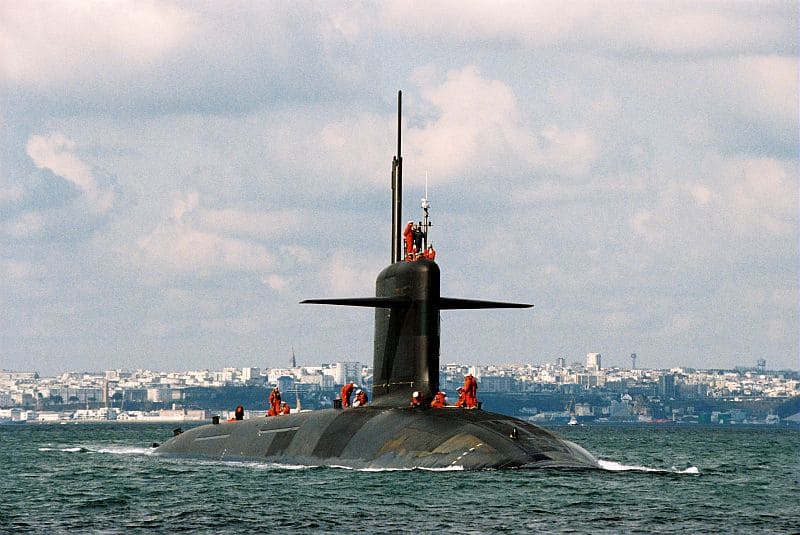
Marine nationale SNLE deterrent at Île Longue and the Triomphant-class submarine fleet
The base functions as the home port for four ballistic missile submarines, Ministère des Armées notes in its public overview of the force. The force is built around the Le Triomphant class and operates from Île Longue as the ocean component of deterrence. That posture depends on predictable maintenance cycles, logistics, and secure perimeter control at the home facility.
Open assessments describe a continuous at-sea posture with at least one submarine on patrol at any time, with other boats preparing, returning, or in maintenance. The goal is a survivable second-strike option, even if land bases face pressure. Analysts also describe average patrol length at about 70 days, which shows how much depends on steady support at the port facility.
Each submarine can carry up to 16 submarine-launched ballistic missiles, and the missile load is central to why Île Longue draws attention. A widely used technical profile describes the M51 system as a multiple-warhead missile, and it lists an approximate range on the order of 8,000 kilometers. The exact performance figures are not the point in this case. The point is that the base supports the only sea-based nuclear force inside the European Union, which raises the sensitivity of any airspace breach.
Estimates of France’s nuclear stockpile vary across public sources, but mainstream research organizations place the number in the low hundreds. That scale, plus the doctrine of continuous patrol, explains why officials treat even small drone incursions as security events, not local nuisances. The threat does not need a warhead or a weapon to matter. A camera, a flight log, and a test of response timing can still yield value to the operator.
Île Longue also sits in a geography that complicates defense against small drones. A coastal setting offers approach routes over water, and low-flying systems can avoid many traditional surveillance patterns. Countering that problem usually relies on a mix of visual reporting, passive detection, radio-frequency sensing, and localized jamming. That mix can disrupt drones without producing debris, which can leave investigators with little physical evidence after the event.
Rennes prosecutor’s office investigation and France’s counter-drone procurement after the breach
The investigation opened in Rennes focused on the overflight itself, with prosecutors stressing the lack of confirmed attribution. That posture aligned with how officials handled other drone cases around sensitive sites in late 2025, with public language built around what could be proven and what could not.
Late 2025 also brought reports of drone activity at other French military locations. France confirmed drone overflights at the Creil base in the final week of November, according to reporting that cited the armed forces. The site hosts military intelligence functions, and reports said drones appeared on multiple nights. Those reports did not resolve who flew the systems, and they added pressure to strengthen detection and response at home installations.
Drone incidents also reached defense-linked industry sites inside France within the same period. In November, reporting described a drone overflight at the Eurenco facility in Bergerac, with an investigation opened after the incident. The reporting treated the event as another example of small unmanned systems testing security at places tied to defense production.
Procurement decisions followed quickly. DMAé announced two support contracts notified on December 26, 2025 to TRUSTCOMS for Infodrone beacons and DroneBlocker systems, under an operational urgency procedure. The statement described a rising drone threat on national territory and in overseas theaters where France deploys forces alongside partners.
According to industry sources, the package aims at faster fielding of detection and jamming that can move between sites and cover low-altitude approaches where fixed defenses can struggle. TRUSTCOMS described its selection as support for French armed forces counter-drone capacity, tied to the contracts notified by DMAé. Public tender data also reflects a formal acquisition track for Infodrone support.
A separate constraint sits outside hardware. Public reporting on the Île Longue case noted that officials weighed legal authority and rules for engagement, especially when drones appear outside narrowly defined restricted zones or cross into areas with civilian air and maritime traffic nearby. That legal edge case helps explain why officials talk about interception and jamming more than kinetic action, even during high-profile breaches.
European military drone incursions since November 2025 and what the cases show
The Île Longue event landed inside a wider run of European drone incidents near military sites in late 2025. In the Netherlands, the defense ministry said forces fired at drones over Volkel Air Base after sightings between 7 p.m. and 9 p.m., with no wreckage recovered. The ministry did not release technical details, and authorities opened an investigation.
The next night brought disruption at Eindhoven Airport, which handles both civilian and military activity. Ruben Brekelmans said air traffic was suspended for hours after drone sightings, and operations resumed later that evening. Investigators did not publicly identify the drone operators, and officials withheld operational details for security reasons.
Brekelmans also used blunt public language after the Volkel event. “Drones are NOT permitted at military sites,” he wrote on social media, and Dutch authorities emphasized that drone flights near airports and military facilities are prohibited. The message did not solve the attribution problem, but it signaled how seriously governments now treat these intrusions, even when the systems are small and short-lived.
Ireland faced a separate security episode during Volodymyr Zelensky’s visit to Dublin in early December. Jim O’Callaghan described the incident as part of a “coordinated threat,” and he said an investigation was underway into drones in Dublin Bay. Zelensky later acknowledged the presence of drones during the visit.
Those European cases share features that matter to base defense planners. The drones often leave no recoverable evidence, and public authorities often avoid public attribution absent proof. The events also show how a drone can create immediate operational disruption, even if it never drops a payload and never approaches a target building.
Our analysis shows the central problem is not detection alone. Governments can spot drones more often than they can identify operators, preserve evidence, and apply response options that fit the legal setting around each site. That mismatch keeps cases open, and it drives urgent buys for portable detection and jamming that can deploy fast across multiple locations.
REFERENCE SOURCES
- https://www.reuters.com/world/europe/france-investigates-reports-drones-over-nuclear-sub-base-2025-12-05/
- https://apnews.com/article/france-nuclear-submarine-base-drone-overflight-f4cac3cfea631c08d74515e69253a982
- https://www.france24.com/en/live-news/20251205-france-takes-anti-drone-measures-after-flight-over-nuclear-sub-base-1
- https://www.euronews.com/2025/12/05/french-soldiers-open-fire-on-drones-over-nuclear-submarine-base
- https://www.lemonde.fr/en/international/article/2025/12/06/france-opts-for-discretion-after-drones-spotted-above-naval-base_6748219_4.html
- https://www.lemonde.fr/en/international/article/2025/12/24/drone-overflights-are-testing-our-defense-capabilities-says-french-military-intelligence-and-security-chief_6748801_4.html
- https://www.reuters.com/business/aerospace-defense/drones-were-spotted-near-zelenskiy-flight-path-dublin-irish-media-report-2025-12-04/
- https://www.reuters.com/world/dutch-military-uses-weapons-against-drones-over-air-force-base-2025-11-22/
- https://www.reuters.com/world/europe/dutch-airport-eindhoven-closes-due-drone-incursions-2025-11-23/
- https://www.iiss.org/online-analysis/online-analysis/2025/12/drones-targeting-european-nuclear-weapons-infrastructure/
- https://www.defense.gouv.fr/dmae/actualites/securiser-lespace-aerien-lutte-anti-drone-urgence-operationnelle
- https://trustcoms.com/en/our-cuav-solutions/
- https://www.mbda-systems.com/mbda-fid-2025-discover-cutting-edge-innovations-defence
- https://www.courthousenews.com/france-takes-anti-drone-measures-after-flight-over-nuclear-sub-base/