Two Congressional Research Service products, published a day apart, can’t agree on what “$17.5 billion” means for Golden Dome. The continuing resolution that followed settled a different question: for now, none of it is protected.
| Document | Figure given | What it says |
|---|---|---|
| CRS R49023, July 7, 2026 | $17.5B + $0.40B | Table A-1 lists Mandatory and Discretionary as two separate request columns for “Golden Dome for America.” Added together, the request totals $17.9 billion |
| CRS IF13264, July 8, 2026 | $17.5B total | “DOD requested $17.5 billion for a ‘Golden Dome for America Fund’… Of the $17.5 billion, $17.1 billion (98%) was requested as mandatory funding” |
The Congressional Research Service is Congress’s own nonpartisan analysis shop, and its products are not supposed to contradict each other on basic arithmetic. Yet CRS Report R49023, published July 7, 2026, lists Golden Dome’s FY2027 request as $17.5 billion in mandatory funding plus $0.40 billion in discretionary funding, two separate figures that sum to $17.9 billion. CRS Insight IF13264, published the very next day by a different pair of authors, describes the request as $17.5 billion total, of which $17.1 billion is mandatory. The two documents cannot both be describing the same number the same way. Whichever framing is right, the more consequential fact is what happened after both were written: the continuing resolution that funds the government through December 11 does not mention Golden Dome at all.
What $24.4 billion actually bought
Golden Dome’s money so far has a precise legislative paper trail, even if press coverage usually rounds it to “$23 billion” or “$25 billion.” Section 20003 of the 2025 reconciliation law, the One Big Beautiful Bill Act, P.L. 119-21, appropriated exactly $24.4 billion for “integrated air and missile defense,” split into two pieces: $18.8 billion for “next-generation missile defense technologies,” and $5.9 billion for “layered homeland defense.” The larger piece is dominated by a single line: $7.2 billion for “the development, procurement, and integration of military space-based sensors,” the biggest individual space-related item in the section, ahead of $5.6 billion for space-based and boost-phase intercept development and $2.55 billion for a consolidated line on missile defense capability development. The homeland-defense piece includes $1.975 billion for ground-based radars and $800 million to accelerate next-generation ICBM defense systems. The money remains available through September 30, 2029.
Enacted in P.L. 119-21 $18.500B + $5.913B = $24.413B Line items summed from CRS IN12576, Table 1. The $333 million difference in the first column is three House provisions the Senate dropped, worth $2.883 billion, less one the Senate added, worth $2.55 billion.
That calculation resolves something CRS leaves hanging. Add up its own component figures and they don’t reconcile: $18.8 billion plus $5.9 billion is $24.7 billion, not the $24.4 billion the same document gives as the total two sentences earlier. The answer sits in the table below that sentence, where CRS states that the House-passed version of Section 20003 would have provided $24.7 billion and the Senate-passed version $24.4 billion. The $18.8 billion is the House subtotal, carried into a sentence about the enacted law. The enacted figure for next-generation missile defense technologies is $18.5 billion. One of the three provisions the Senate dropped was $300 million for classified military space superiority programs run by the Strategic Capabilities Office.
One detail in the bill’s drafting history matters more than it first appears. The House-passed version would have required the Department to submit a detailed spending plan to Congress within 45 days of enactment. That requirement did not survive the Senate’s version, and it is absent from the law that was signed. Congress funded the program without building in the one mechanism that would have forced early transparency about how the money was being spent, a choice whose consequences showed up seven months later, when appropriators complained they still hadn’t gotten the information they needed.
They said so explicitly. In the report accompanying the FY2026 defense spending bill, House and Senate appropriators wrote that they “were unable to effectively assess resources available to specific program elements and to conduct oversight of planned programs and projects for fiscal year 2026 Golden Dome efforts,” citing the Department’s failure to provide a master deployment schedule, cost and schedule metrics, or a finalized system architecture. Section 1652 of the FY2026 NDAA had already tried to force the issue in law, requiring an annual report covering a threat assessment, system architecture, and cost and schedule estimate. As of early 2026, lawmakers said the information still had not arrived in usable form.
The FY2027 ask, and what committees have actually written down
Whether one reads it as $17.5 billion or $17.9 billion, the FY2027 request repeats the reconciliation-heavy structure of FY2026 almost exactly: the vast majority is “mandatory” funding contingent on a second reconciliation bill, with a comparatively small discretionary slice moving through the ordinary appropriations process. That slice is $400 million, which R49023 states directly in its discretionary column and IF13264 arrives at by subtracting its $17.1 billion mandatory figure from its $17.5 billion total. It is a separate number from the $434 million IF13264 cites for “Army Operations and Maintenance and Research, Development, Test, and Evaluation,” which is the Army’s own share of the overall Golden Dome Fund rather than a competing estimate of the discretionary total. The two figures are close enough to invite confusion and measure different things.
- Request, mandatory
- $17.5B via reconciliation
- Request, discretionary
- $0.40B
- HASC, authorized
- $0.40B
- SASC, authorized
- $0.40B
- HAC, appropriated
- $0.40B
- Mandatory portion enacted
- none
The pattern is identical to two programs this outlet has already tracked through the same committees: the Defense Autonomous Warfare Group and the interceptor procurement lines for PAC-3 MSE and THAAD. In each case the committees have matched the discretionary request to the dollar and left the mandatory column untouched, because the reconciliation vehicle meant to carry it does not exist yet.
Golden Dome’s overlap with the interceptor story may be literal rather than merely structural. The Army’s own FY2027 accounting, laid out in a July 8 CRS brief, shows it requested $11.4 billion for THAAD procurement and $12.2 billion for PAC-3 MSE procurement as part of the broader Golden Dome effort, with 92 percent and 89 percent of those two totals respectively also structured as mandatory funding. Those figures do not match the $12.49 billion and $13.96 billion this outlet cited for the same two systems from CRS’s separate R49023 weapon-system tables, which is a reminder that even CRS’s own internal cross-references for Golden Dome don’t fully agree. The Department has said it can allocate these systems to homeland or theater missile defense, meaning some of the same interceptor dollars sitting unaddressed in this outlet’s earlier reporting on the Iran war’s munitions drawdown are also, on paper, part of Golden Dome’s request.
“There is no Golden Dome”
The person responsible for the program said as much himself, in public, before any of this reached a vote. At the Space and Missile Defense Symposium in Huntsville, Alabama, on August 11, Space Force Gen. Michael Guetlein, the director of Golden Dome for America, told the room that 90 percent of $22.5 billion in Golden Dome funding had been obligated and 95 percent committed to contracts, covering radars, launchers, space-based interceptors, hypersonic tracking systems and military construction. His base figure sits $1.9 billion below the $24.4 billion the reconciliation law appropriated, and the gap is not explained in his remarks.
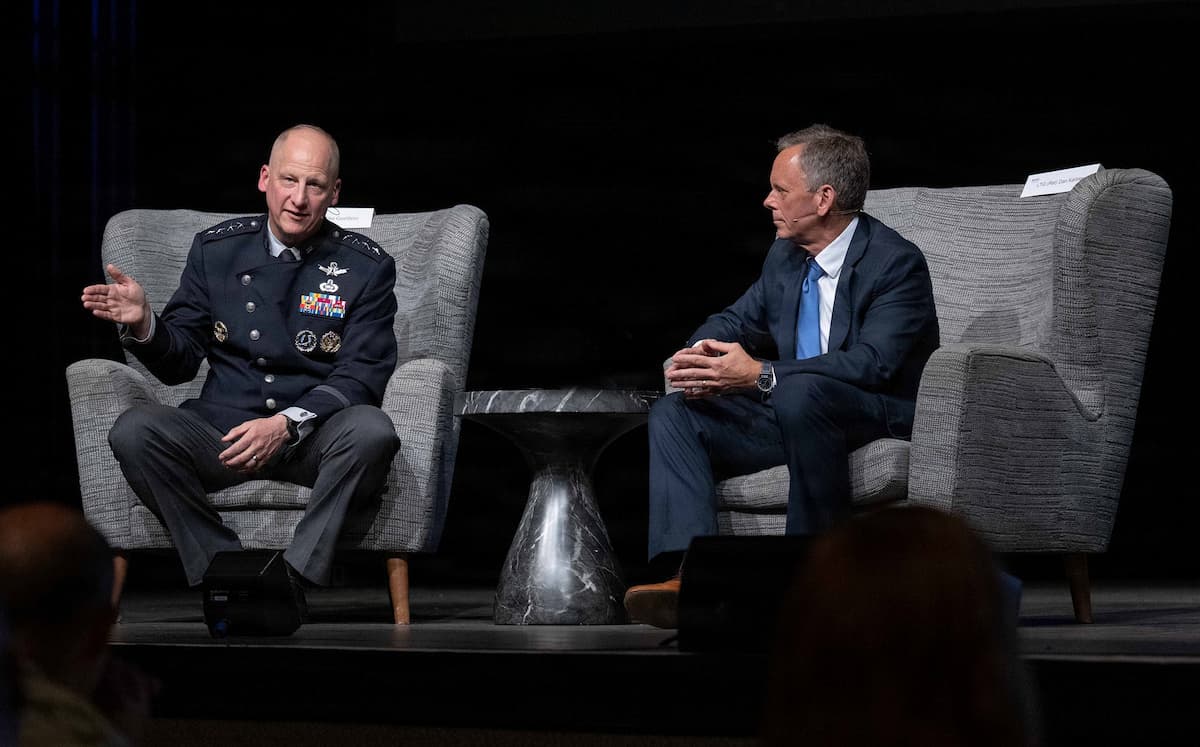
“Both sides of the aisle, as well as the House and the Senate, are working through the math about how to do this in ’27. I will tell you that if they don’t figure it out, there is no Golden Dome.”
Guetlein was explicit about why a continuing resolution, the mechanism Congress typically reaches for when full-year appropriations aren’t ready, would not help this particular program. A CR extends the prior year’s funding rate, and Golden Dome does not have a prior year’s discretionary rate to extend, because nearly all of its money has come through reconciliation rather than the annual appropriations bills a CR is built to continue.
Two weeks later, the Air & Space Forces Association sent congressional leaders a formal letter making the same point and asking for two specific fixes: fund the full FY2027 Golden Dome request even inside a stopgap bill, and write in statutory language authorizing “new starts,” since a standard CR prohibits federal agencies from beginning work not already funded in the prior fiscal year. Virtually everything in Golden Dome’s FY2027 plan is, by definition, new.
What the CR actually did
The continuing resolution Congress passed to keep the government funded, H.R. 6500, the Continuing Appropriations and Extensions Act, 2027, signed into law September 2, 2026 as P.L. 119-103, runs through December 11, 2026. Reading the enacted text directly answers the question AFA’s letter raised and this outlet’s earlier reporting left open: did Congress grant Golden Dome the exception it asked for?
It did not. The bill lists specific, named exceptions to its general spending restrictions, among them cost growth on twenty individually enumerated Navy shipbuilding programs, $2.853 billion for National Security Systems inside Defense-Wide procurement, and several National Nuclear Security Administration projects. Golden Dome appears in none of them. Section 102(a) bars the Department of Defense from using CR funds for “the new production of items not funded for production in fiscal year 2026 or prior years,” from increasing production rates above FY2026 levels, or from initiating “any project, activity, operation, or organization” that did not have appropriations, funds, or other authority in FY2026. Because Golden Dome’s FY2026 money came almost entirely through reconciliation rather than the annual defense appropriations act this CR extends, the program is left to rely on whatever narrow reading of “continuing” activity the Pentagon’s own lawyers can construct, not on language Congress wrote for it.
What to watch
None of the three has happened as of this writing. The oversight question sits alongside the funding question rather than behind it: even if a second reconciliation bill materializes, it would arrive under the same conditions that produced the FY2026 complaint, a mandatory-funding vehicle that by its nature gives appropriators less line-item visibility than the annual process it bypasses. Nothing in the FY2027 request or the committee actions tracked here changes that structure. Until one does, the $17.5 billion figure attached to Golden Dome’s homeland missile shield, whichever of CRS’s two versions of that number is used, describes an ambition rather than a budget.
Sources
Primary and official documents
- Congressional Research Service — FY2027 Defense Budget: Funding for Selected Weapon Systems (R49023), July 7, 2026, Table A-1
- Congressional Research Service, Andrew Feickert and Hannah D. Dennis — The U.S. Army and the Golden Dome Program (IF13264), July 8, 2026
- Congressional Research Service, Hannah D. Dennis and Daniel M. Gettinger — Golden Dome: Funding in the 2025 Reconciliation Law (IN12576), updated July 10, 2025, Table 1
- H.R. 6500 — Continuing Appropriations and Extensions Act, 2027, enacted text, Sec. 102(a) and the anomaly sections
- AAMC — President Signs Continuing Resolution Extending FY26 Funding to December, September 2026, for the signing date and P.L. 119-103 designation
- Air & Space Forces Association — Letter on Golden Dome Funding and Continuing Resolutions, August 25, 2026
- Taxpayers for Common Sense — Missing the Mark: Why Golden Dome is Bad for American Taxpayers (PDF), February 2026, for the Section 1652 reporting requirement
Trade press and analysis
- Aviation Week — Golden Dome Faces Budget Uncertainty Amid Growth, August 12, 2026, for the obligation and commitment figures
- Air & Space Forces Magazine — Budget Instability Puts Golden Dome at Risk, Guetlein Warns, August 11, 2026
- Breaking Defense — If funding falters, “there’s no Golden Dome,” Guetlein warns, August 11, 2026
- DefenseScoop — Guetlein: Golden Dome in jeopardy due to 2027 funding uncertainty, August 12, 2026
- SpaceNews — Golden Dome faces 2027 funding cliff, August 12, 2026
- Defense One — Where’s all the Golden Dome money going? Lawmakers want to know, January 23, 2026
Related coverage
- DAWG Asked for $54.6B. Three Committees Wrote Down $1B, for the same mandatory-versus-discretionary pattern in another program
- The FY2027 Request: $1.5 Trillion, and What It Actually Buys, for the topline context this piece does not repeat
Editor’s note: the $17.5B and $17.9B discrepancy described here reflects two Congressional Research Service products compared directly, not a claim about which figure is correct; CRS does not resolve the inconsistency in either document. The THAAD and PAC-3 MSE totals attributed to Golden Dome in IF13264 do not match the totals for the same two systems in R49023’s weapon-system tables, and both are reported here rather than reconciled. Obligation and contract-commitment rates are as stated by Gen. Michael Guetlein on August 11, 2026, against a base figure he did not reconcile to the appropriated total. The quote from House and Senate appropriators was read via press reporting rather than the underlying committee report.