Five months after the Pentagon’s headline budget request, three congressional committees have written down a figure for the same organization, and it isn’t $55 billion.
- Requested, discretionary
- $1.00B
- Requested, mandatory
- $53.6B via reconciliation
- HASC, authorized
- $1.00B
- SASC, authorized
- $1.00B
- HAC, appropriated
- $1.00B
- Mandatory enacted to date
- none
On April 3, 2026, the White House sent Congress a fiscal 2027 defense budget built around one striking figure: $54.6 billion for the Defense Autonomous Warfare Group, up from roughly $225 million a year earlier, an increase of more than 240-fold that made DAWG’s single budget line larger than the entire proposed FY2027 budget for the U.S. Marine Corps. That framing drove most of the coverage. Five months later, it is no longer the operative number. The House Armed Services Committee, the Senate Armed Services Committee and the House Appropriations Committee have each independently written down the same figure for DAWG: $1 billion.
DAWG itself is not new. It is the successor to the Pentagon’s Replicator drone initiative, absorbed into U.S. Special Operations Command after Replicator was wound down in 2025. The FY2027 request arrived alongside a related announcement: on April 29, Secretary of War Pete Hegseth told the House Armed Services Committee the Department would “shortly announce a sub-unified command of autonomous warfare,” modeled, he said, on the Joint Special Operations Command. Eight days earlier, U.S. Southern Command had already stood up a command of its own for the same mission area. Whether these are the same organization is a question the Pentagon has yet to answer on the record.
What the ledger says now
The Congressional Research Service’s line-item accounting of the FY2027 request, updated July 7, shows why $54.6 billion was always shorthand for something more conditional. DAWG’s request was never a single figure: $1.0 billion of it was discretionary, ordinary appropriated funding, and $53.6 billion was mandatory, meaning it depended on Congress separately passing a reconciliation bill.
That distinction matters because reconciliation and regular appropriations move through different committees on different timelines, and only the $1 billion discretionary piece has moved anywhere at all. The House Armed Services Committee’s FY2027 defense policy bill, H.R. 8800, reported June 15, authorizes $1.0 billion for DAWG. The Senate committee’s version, S. 4784, reported the same day, authorizes the same $1.0 billion. The House Appropriations Committee’s defense spending bill, H.R. 9495, reported June 26, appropriates $1.0 billion. None of the three entered a figure against the $53.6 billion mandatory request. The Congressional Research Service’s own table simply leaves it blank.
The committees did not reject the $53.6 billion. They were not in a position to act on it. Mandatory funding reaches the armed services committees only through reconciliation instructions issued by the budget committees, and those instructions did not exist until the House adopted a budget resolution on July 22, more than a month after the NDAA markups.
The blank column records a stage of the process rather than a verdict on the request. What it does establish is that with the fiscal year approaching, the only money actually written down for DAWG anywhere is the discretionary billion.
Jules W. Hurst III, then the Pentagon’s acting comptroller, told reporters at the April 21 budget rollout that the mandatory funds were meant for programs that were “kind of a one-time plus up” the Department wanted, giving it more flexibility on when it obligated the money. Nine days after the rollout, at an April 30 hearing on the Air Force and Space Force budget, House defense appropriations subcommittee chairman Rep. Ken Calvert told service officials he would rather see priority needs funded in the base budget or in the supplemental. His own committee acted on that preference six weeks later, when it left DAWG’s mandatory request untouched entirely.
The Senate committee went further than silence. Section 837 of its NDAA restricts funds available to DAWG, grouped unusually with the Secretary of Defense’s own travel budget, until the Department delivers reports Congress had already required in earlier defense bills. It is a narrow, technical provision, but it reads less like enthusiasm for a blank check and more like a committee asking for paperwork before money.
A name missing from its own paperwork
A separate check of the Pentagon’s own FY2027 Procurement Programs exhibit, the P-1, the 335-page ledger the Department files with Congress account by account, turns up no organization called the Defense Autonomous Warfare Group. Neither DAWG, nor Drone Dominance, nor Autonomous Warfare, nor Replicator appears anywhere in the document. The closest related entry is a separate $800 million line for Counter-Small Unmanned Aircraft Systems under the Defense-Wide procurement account, a real and discrete program, and not DAWG.
That absence is consistent with how CRS built its own figures in the first place: not from the P-1 or its research-funding counterpart, the R-1, but from a separate Pentagon summary document, Program Acquisition Cost by Weapon System. In practice, DAWG functions as a label applied across multiple existing procurement and research accounts rather than a program element with a line of its own, closer to a budget category like hypersonics or artificial intelligence than to a single weapons program a contracting officer could look up by number. For an organization whose entire premise is unprecedented scale, that is worth noting on its own terms: the accounting for it does not yet work the way the accounting for a $54.6 billion program normally would.
Four commands, one story
Coverage since April has often treated “a new command for autonomous warfare” as a single proposal. It is at least four, with different sponsors, different legal standing, and no confirmed relationship to one another.
| Entity | Standing | What it actually is |
|---|---|---|
| Defense Autonomous Warfare Group | Established | A SOCOM-subordinate organization, not a command. Successor to Replicator. The budget vehicle at the center of this story, not itself a headquarters |
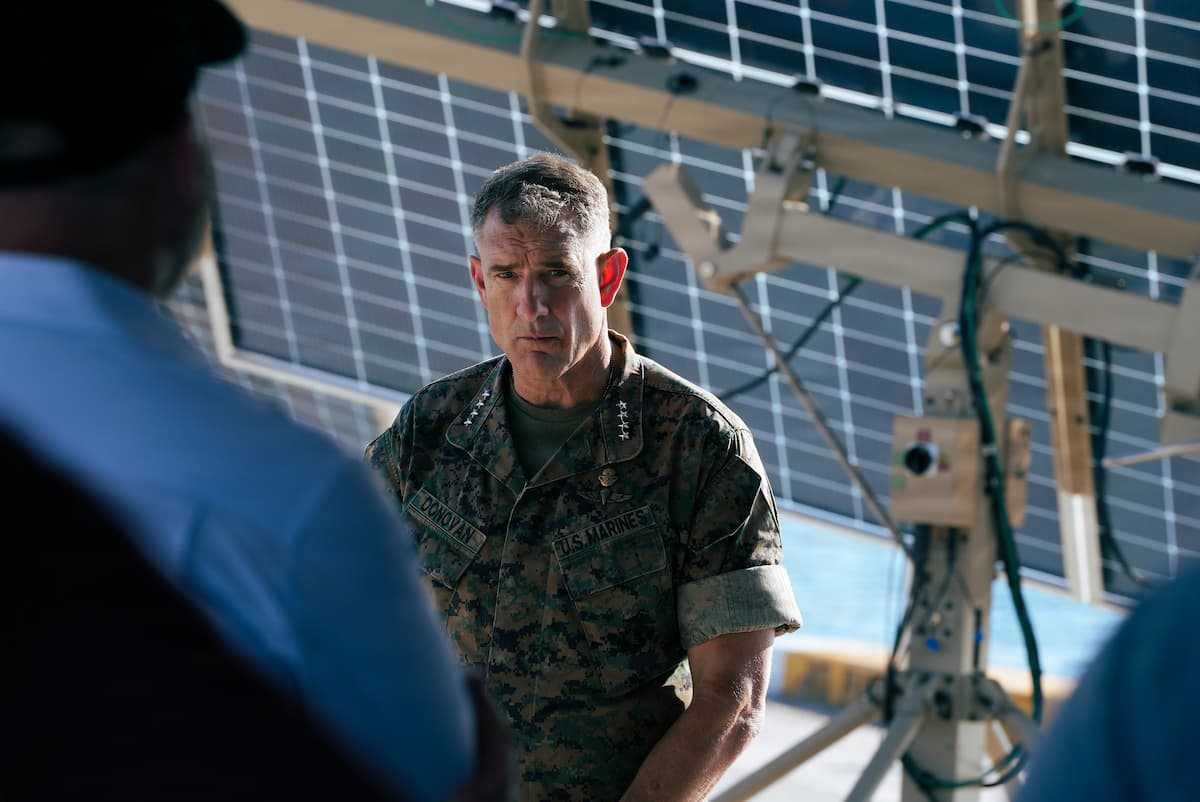
| SOUTHCOM Autonomous Warfare Command | Established | Directed April 21, 2026 by Marine Corps Gen. Francis L. Donovan. A theater command for SOUTHCOM’s own mission, to be built partly with capability sourced through DAWG |
| Sub-unified command “similar to JSOC” | Unannounced | Promised by Secretary Hegseth on April 29, 2026. Not stood up as of this writing. The Pentagon has not confirmed whether it is distinct from SOUTHCOM’s command |
| Robotic and Autonomous Systems Combatant Command | Optional, Senate only | A proposed four-star combatant command in the Senate’s FY2027 NDAA. The bill permits, rather than requires, its creation. Absent from the House-passed NDAA |
SOUTHCOM’s command is real and narrow: built to apply autonomous and unmanned systems to the command’s own mission of countering cartel networks and responding to regional disasters, and, per the command’s own announcement, to draw on capability identified through DAWG. Hegseth’s sub-unified command, announced a week later at the same HASC hearing that unveiled the budget, has not followed with an announcement of its own. When DefenseScoop asked the Pentagon directly whether Hegseth’s promised command was the same organization SOUTHCOM had just stood up, a Pentagon spokesperson referred the outlet back to the secretary’s own testimony rather than answering the question.
The fourth entity does not depend on an answer to that question at all. The Senate Armed Services Committee’s FY2027 NDAA, reported June 15, includes a provision the committee’s own summary describes as encouraging the Department “to adopt the future of warfare by permitting the establishment of the Robotic and Autonomous Systems Combatant Command.” The wording is deliberate: permitting, not requiring. The House’s version of the NDAA, passed on the floor 216 to 212 on July 22, contains no equivalent provision.
A four-star combatant command, the first proposed since Space Command’s 2019 re-establishment, currently exists in exactly one chamber’s bill, as an option rather than an instruction. That bill has not reached the Senate floor: a cloture vote on the motion to proceed to S. 4784 failed 50 to 46 on July 14, with Senate Democrats blocking it over the Iran war and the size of the defense topline.
The vehicle that was never big enough
Even before any committee marked up a bill, the $53.6 billion mandatory request for DAWG faced a structural problem: the reconciliation vehicle meant to carry it. At the Navy League’s Sea-Air-Space conference on May 4, HASC Vice Chairman Rep. Rob Wittman told reporters that passing $350 billion in defense reconciliation funding was “going to have its challenges,” while Rep. Donald Norcross argued reconciliation was simply not the right tool, warning it risked Congress “seceding” its own power of the purse.
Those doubts hardened into arithmetic in July. On July 22, the same day it passed the FY2027 NDAA, the House adopted a budget resolution, H.Con.Res. 113, by 216 to 214. The resolution carries $95 billion in reconciliation instructions, of which $60 billion is for defense, against the $350 billion the administration had requested. That is not a haircut; it is a different order of magnitude, and DAWG’s $53.6 billion mandatory request alone would consume nearly all of it. How the $60 billion is divided remains unsettled: the House Armed Services Committee has yet to write the spending plan.
A tracker published by the Center for Strategic and International Studies in early September found full-year discretionary appropriations unlikely before December, with both chambers running on continuing resolutions and reconciliation’s fate and overall amount still unresolved. Separately, the White House’s own June 24 supplemental request for the costs of U.S. military operations against Iran, which Pentagon officials had said in April could overlap with FY2027 weapons requests, leaves open the possibility that money now labeled DAWG, FY2027 resurfaces instead inside a faster-moving, Iran-linked bill.
What this doesn’t settle
None of this means DAWG’s money is dead, or that a four-star autonomous-systems command will never exist. Reconciliation bills have moved on compressed timelines before, and a continuing resolution buys the administration more legislative innings than an outright rejection would. But the figure that made this story in April, $54.6 billion and a 243-fold increase and larger than the Marine Corps, described a request, not an appropriation. Five months on, the number three committees have actually written down for the fiscal year is $1 billion; the organization drawing it has no line of its own in the Pentagon’s procurement ledger; and the command meant to use it is, depending on which official is asked, either already standing in Miami, still unannounced in the Pentagon, or an option sitting in one half of a divided Congress.
Sources
Primary and official documents
- Congressional Research Service — FY2027 Defense Budget: Funding for Selected Weapon Systems (R49023), July 7, 2026, Table A-1 and Appendix
- Department of War, Office of the Under Secretary of War (Comptroller) — Procurement Programs (P-1), FY2027 (PDF), April 2026, 335 pages
- U.S. Southern Command — SOUTHCOM Establishes Autonomous Warfare Command, press release, April 21, 2026
- Department of War — Hurst and Whitney press briefing transcript, April 21, 2026
- Congressional Research Service — FY2027 NDAA: Status of Legislative Activity (IN12704), updated July 24, 2026
- House Committee on Appropriations, Subcommittee on Defense — Budget hearing, U.S. Air Force and Space Force, video, April 30, 2026; the Calvert remark begins at 26:28
Trade press and analysis
- DefenseScoop — Southcom creates new Autonomous Warfare Command to build up its drone prowess, April 22, 2026
- Breaking Defense — House passes 2027 NDAA while measure remains stalled in the Senate, July 22, 2026
- Air & Space Forces Magazine — House Passes 2027 NDAA, Reconciliation Package, July 23, 2026
- Center for Strategic and International Studies — Tracking FY 2027 Defense Appropriations, Reconciliation, and the Supplemental Request
- DroneXL — Pentagon requests $75 billion for drones in FY27, April 21, 2026, for the FY2026 baseline and the SOCOM transition