The Pentagon has reversed course on the E-7 twice in two budget cycles. Only one of those reversals has a dollar figure attached to it in an actual bill.
- DoD request
- none requested
- HASC, authorized
- none
- SASC, authorized
- $1.50B
- HAC, appropriated
- $1.55B
- SAC
- bill not yet reported
- Enacted, either chamber
- none
The Department of Defense asked for zero dollars for the E-7A Wedgetail in its fiscal 2027 budget request, submitted April 3, 2026. It was the second consecutive year the Department had tried to zero out the program, and this time it did so more completely than in FY2026, when at least a small residual request survived. Five months later, two congressional committees have written different numbers into their own bills for the same aircraft, a third hasn’t acted, and the House committee most associated with saving the E-7 a year earlier, the House Armed Services Committee, has authorized nothing for it at all.
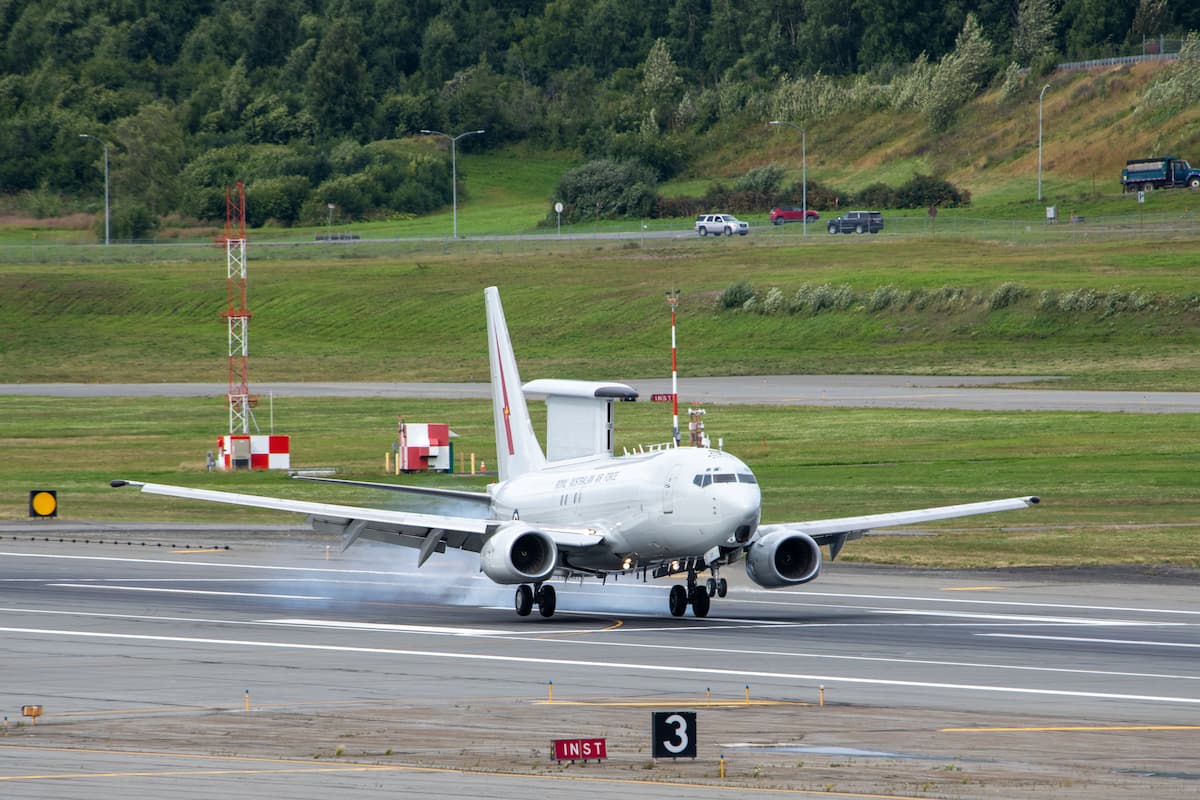
The Wedgetail, a Boeing 737-based airborne early warning and control aircraft already flying with Australia, South Korea, Turkey and soon the United Kingdom, was meant to replace the Air Force’s aging E-3 Sentry fleet under a program the service first announced in 2022. The Air Force moved to cancel it in 2025, arguing that space-based sensors would eventually take over much of the mission and that the E-7 was too expensive and too vulnerable to survive in contested airspace. Congress disagreed, restored funding in the FY2026 defense bills, and went further: the enacted FY2026 NDAA barred the Department from using its funds to terminate the E-7’s prototype contract or shut down its production line, and separately barred the Air Force from retiring any of its 16 remaining E-3s if doing so would cut the fleet below that number. The fight looked settled until the FY2027 request repeated the cancellation attempt almost exactly, before an event in the Middle East changed the calculation.
The FY2026 rehearsal
The pattern now playing out in FY2027 has a direct precedent, and the paper trail for it is unusually explicit. On September 8, 2025, the White House Office of Management and Budget issued a formal Statement of Administration Policy on the House’s FY2026 defense bill. Its position on the E-7 was unambiguous.
“The Administration strongly opposes authorizing additional funds for the E-7 and supports cancelling the E-7 due to the platform’s survivability limitations and significant cost — $2.6 billion for the first two planes.”
Congress did it anyway. The House Armed Services Committee’s own bill had already authorized $800 million for the E-7 despite that objection; the Senate Armed Services Committee went further, at $900 million. Lawmakers pushed on a third front, too: a short-term spending bill enacted in November 2025 to end a government shutdown added a separate $200 million tranche for the program, on top of whatever the annual bills would eventually provide. The negotiated NDAA that became law on December 18, 2025, settled on $850 million, and the separate defense appropriations act, signed in February 2026, ultimately provided $1.10 billion, both above what the Administration had requested and explicitly against the White House’s stated position three months earlier. The reversal was total: by December, OMB’s Statement of Administration Policy on the negotiated bill said only that the Administration “strongly supports” its passage.
| Stage | FY2026 | FY2027 |
|---|---|---|
| DoD request | $0.20B | none |
| HASC, authorized | $0.80B | none |
| SASC, authorized | $0.90B | $1.50B |
| Enacted NDAA | $0.85B | not enacted |
| HAC, appropriated | $0.50B | $1.55B |
| SAC, appropriated | $0.85B | not yet reported |
| Enacted appropriations | $1.10B | not enacted |
Laid side by side, the two cycles look less like a straight line from cancellation to restoration and more like a rerun with a slower cast. In FY2026, both authorizing committees moved on their own, ahead of any administration reversal, and the enacted numbers landed close to what they had proposed. In FY2027, only one authorizing committee, the Senate’s, has done the same; the House’s has not, and neither chamber’s appropriators have finished the job either.
The FY2027 repeat, and the reversal
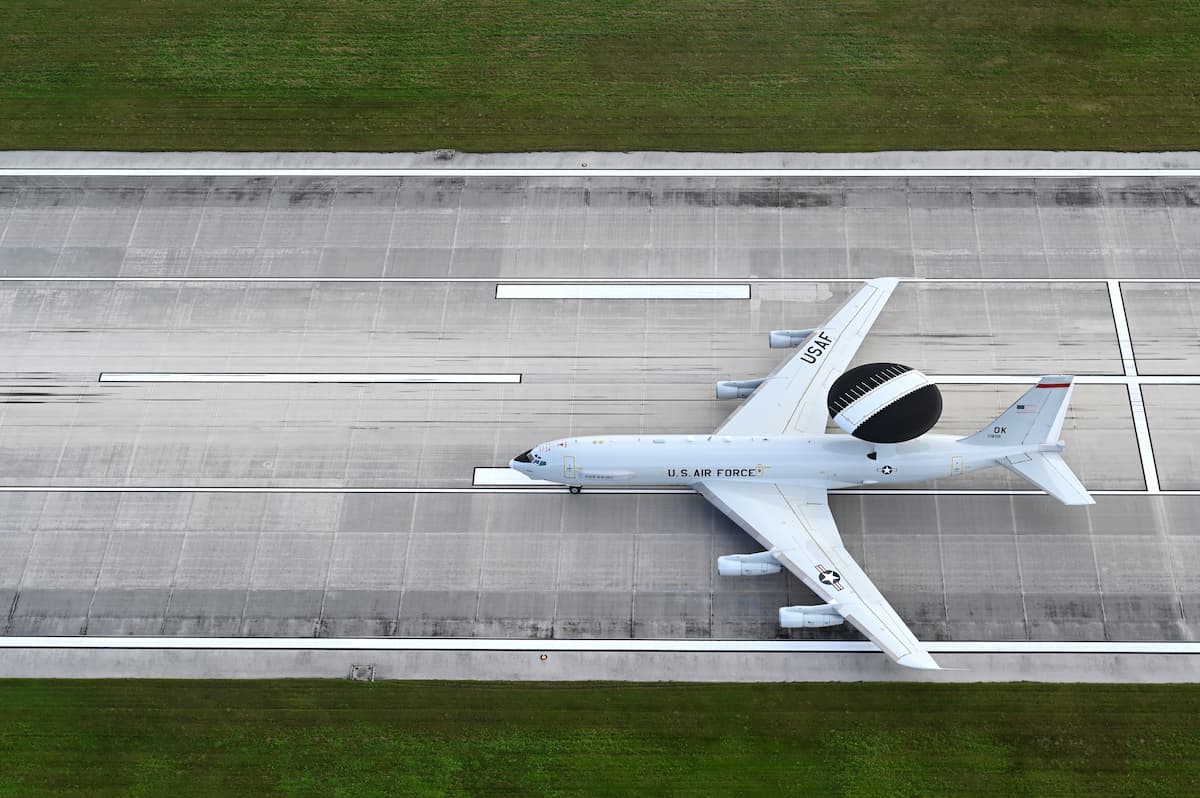
None of that history stopped the Pentagon from trying again in April 2026, this time with an even cleaner zero than the year before. What changed the outcome wasn’t lobbying pressure alone. On March 27, 2026, an Iranian missile and drone attack on Prince Sultan Air Base in Saudi Arabia destroyed a U.S. Air Force E-3 Sentry, tail number 81-0005, the first combat loss of a U.S. AWACS aircraft in the type’s history. With the E-3 fleet already down to 16 airframes, the loss of even one aircraft was a visible reminder of exactly the capability gap the E-7 was meant to close.
On May 12, at a House Appropriations hearing where committee chairman Tom Cole pressed him directly on the E-7’s absence from the budget, Defense Secretary Pete Hegseth said the Department’s “mindset” on the aircraft had changed. On June 17, the White House Office of Management and Budget sent a formal budget amendment to House Speaker Mike Johnson: $1.55 billion for the E-7, funded by pulling $651 million from the Navy’s E-2D Hawkeye procurement account and $899 million from a classified line in the Air Force’s “Other Procurement” account. The maneuver was designed to be budget-neutral: the Pentagon proposed to pay for one aircraft’s revival by cutting another’s.
The House Appropriations Committee didn’t take the deal as offered. Its report accompanying the FY2027 defense spending bill backed the $1.55 billion for the E-7, but rejected the Navy offset outright, restoring the $651 million the White House had tried to take from the E-2D Hawkeye line. The committee’s own language framed the two aircraft as complementary, not competing.
“As the E–3 is set to retire, the E–7 Wedgetail will serve as modern replacement for lost battle management capability.”
The result is that the House’s appropriators funded both aircraft in full rather than one at the other’s expense, a more expensive outcome than the Administration’s own amendment proposed, and one that undercuts the idea that Congress simply rubber-stamped the White House’s request once it arrived.
Told in May, silent in June
The detail missing from most coverage is that the House Armed Services Committee did not learn of the reversal from OMB’s letter. It heard about it from the Air Force directly, a month earlier. Air Force Secretary Troy Meink told the committee in May that a budget amendment was coming, in his words “in the ballpark of around $1.5 billion.”
The committee reported its version of the FY2027 NDAA on June 15, two days before OMB’s amendment letter reached Capitol Hill on June 17. On the narrow question of paperwork, its bill text was therefore locked before the Administration’s revised request existed in writing. But timing alone does not account for the blank line, because the figure had already been named to the committee’s own members from the witness table. The Senate Armed Services Committee, which reported its bill the same day and had heard the same testimony, added $1.50 billion anyway, much as it had overridden OMB’s objections the year before.
What is harder to explain, five months on, is why the gap has not since closed. The House passed its full NDAA on the floor, 216–212, on July 22, more than a month after OMB’s amendment was public, and the bill still carries no E-7 procurement or research funding. The same committee that added $800 million to the E-7 line on its own initiative in 2025, before any administration reversal existed, has now had a formal, written, administration-endorsed funding request sitting in front of it since mid-June and has not moved a line item to match it. The Senate did try to move: the Majority Leader filed cloture on a motion to proceed to its NDAA on June 24, but the cloture vote failed, 50-46, on July 14. No further procedural steps toward a floor vote have followed, and the Senate Appropriations Committee has not yet reported a defense spending bill at all.
What $1.55 billion actually buys
It is also worth being precise about what the money under discussion would fund, because “reviving the E-7” and “restarting production” are not the same claim. When the Air Force first announced its intention to buy Wedgetails in 2022, the plan called for an eventual fleet of 26 operational aircraft, with the two initial prototypes slated for delivery in fiscal 2028 and a production decision, the gate that would start deliveries of the remaining operational-configuration jets, expected in fiscal 2026. A program the Pentagon’s own September 2025 cost figure priced at $2.6 billion for just those first two airframes. Nothing currently in either chamber’s bill text restores that broader program of record or sets a new production decision date. What OMB’s amendment and the House Appropriations Committee’s $1.55 billion actually cover is narrower still: the two prototype aircraft already under contract, plus five additional engineering-and-manufacturing-development jets, seven airframes in total, none of them the production-configuration aircraft the Air Force originally planned to field.
Those seven aircraft are not interchangeable with a resumed production line, either. The two prototypes are early-build airframes committed to flight test, not combat-ready jets, and per a 2025 modification agreement between Boeing and the UK Ministry of Defence both are being converted at a Boeing-run facility in Birmingham, England, the same line handling the Royal Air Force’s own Wedgetail buy, rather than at a U.S. production facility. Whether that arrangement continues once the five EMD aircraft move from paper to metal is one of the questions neither the SASC nor the HAC bill language answers. Beyond those seven jets, there is no funded plan for the remaining nineteen aircraft of the original program of record, no committee report commits to restarting a production decision, and the Air Force has not said when, or whether, it will ask for one. The $1.55 billion under discussion, in other words, buys the Pentagon time and two more years of prototype work, not the fleet the program was originally built to deliver.
What to watch
Until then, the $1.55 billion figure attached to the E-7’s revival describes what two of four relevant committees have proposed, not what the aircraft is funded to receive in fiscal 2027. The same authorizing committee that moved first and unprompted a year ago has, so far, moved last.
Sources
Primary and official documents
- Congressional Research Service — FY2027 Defense Budget: Funding for Selected Weapon Systems (R49023), July 7, 2026, Table 1
- Congressional Research Service — FY2026 Defense Budget: Funding for Selected Weapon Systems (R48860), updated July 2, 2026, Table 1
- Congressional Research Service — FY2026 NDAA: Summary of Funding Authorizations (IN12641), January 20, 2026
- Congressional Research Service — FY2027 NDAA: Status of Legislative Activity (IN12704), updated July 24, 2026
- Office of Management and Budget — Statement of Administration Policy on H.R. 3838 (PDF), September 8, 2025
Trade press and analysis
- Air & Space Forces Magazine — Pentagon Leaves E-7 Out of Budget for 2027, April 23, 2026
- Air & Space Forces Magazine — Key USAF E-3 AWACS Aircraft Damaged in Iranian Attack, March 29, 2026
- Air & Space Forces Magazine — Pentagon Finds $1.55B for E-7 Wedgetail, Mostly in Classified Budget, June 23, 2026, also the source for Secretary Meink’s May testimony to HASC
- Air & Space Forces Magazine — House Makes Moves to Block Pentagon from Canceling E-7 Wedgetail, July 2025, for the 26-aircraft program of record and the original schedule
- CNN — Destruction of vital US radar aircraft could hamper ability to spot Iran threats, March 30, 2026
- Breaking Defense — Hegseth says E-7 Wedgetail has a future, reversing planned cancellation, May 12, 2026
- Inside Defense — OMB would shift $1.5B from Navy, Air Force procurement to fund Wedgetail, June 18, 2026
- Military Times — House backs $1.55 billion to revive E-7 Wedgetail, spares Navy Hawkeye, June 25, 2026
- The War Zone — E-7 Wedgetail Radar Jet Program Cancellation Reversal Advances in Congress, December 9, 2025
- The War Zone — Pentagon’s Mindset on E-7 Radar Aircraft It Tried to Axe Has Completely Changed: Hegseth, May 12, 2026
- The Aviationist — Boeing to Convert USAF E-7 Rapid Prototypes in UK, September 23, 2025