The U.S. Marine Corps has backed live evaluations of the Low-Cost Uncrewed Combat Attack System, known as LUCAS, at the U.S. Army’s Yuma Proving Ground in Arizona. The Army described LUCAS as a one-way attack aircraft and said the work supports the Marines’ push for longer-range expendable strike drones.
U.S. Central Command has also disclosed an operational deployment of LUCAS drones to the Middle East under a new organization, Task Force Scorpion Strike. Defense officials confirm the air vehicle came from reverse-engineering a damaged Iranian Shahed-136 obtained years ago, with U.S. industry adapting the same delta-wing layout for American use.
US Marine Corps LUCAS one way attack drone test at Yuma Proving Ground
Army reporting on the Yuma event describes a Marine-sponsored evaluation cycle now running on the range. The test venue offers controlled airspace and instrumentation that supports repeatable sorties, with range staff working through safety and certification steps before weapons tests begin.
Col. Nicholas Law, identified as Director of Experimentation in the Office of the Under Secretary of War for Research & Engineering, tied the effort to scale and unit cost. “There is a price point that we want to produce a lot of these in a rapid fashion,” Law said. “It’s not a single manufacturer: it’s designed to go to multiple manufacturers to be built in mass quantities.”
Yuma’s current flights do not include live explosives. The Army said the future warhead “isn’t constructed yet,” and the proving ground is flying the air vehicle with inert payloads while evaluators build out the test program.
Law also pointed at how the range supports later steps once the munition is ready. “The facility itself gives us the flexibility to do what we need, and at the same time will allow for full-fledged testing when it is ready,” he said. “We’re getting our baby steps in before we conduct safety certification testing.”
Testing at Yuma also lines up with work tied to sensor and autonomy functions. “Once we start weaponization and automated target recognition, we can have a target that is a representation of a real target,” Law said. The statement tracks with how one-way drones are evolving, with seekers and recognition software now appearing on cheaper classes of strike systems.
CENTCOM Task Force Scorpion Strike LUCAS drones deployed to the Middle East
CENTCOM announced Task Force Scorpion Strike on Dec. 3 and called it the U.S. military’s first one-way-attack drone squadron based in the Middle East. The command said the force already formed a squadron of LUCAS drones “currently based in the Middle East,” with the organization launched four months after Secretary of War Pete Hegseth directed faster acquisition and fielding of affordable drone technology.
CENTCOM’s statement describes an air vehicle built for range and flexible launch. The command said LUCAS has “an extensive range,” can operate autonomously, and can launch by catapult, rocket-assisted takeoff, or from mobile ground and vehicle systems.
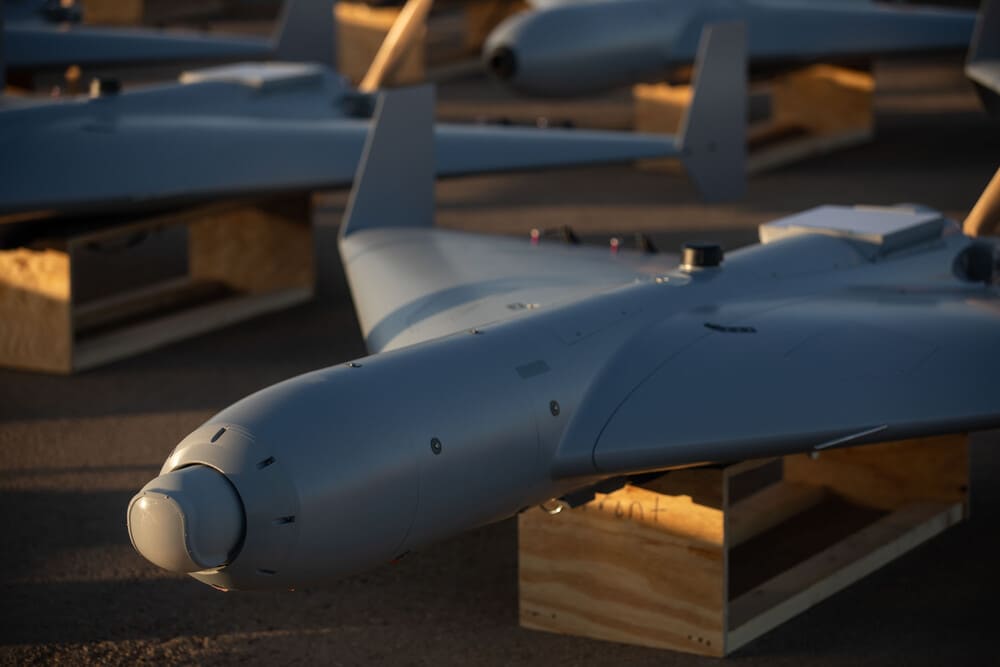
A CENTCOM-released photo shows rows of LUCAS drones staged on a tarmac in the command’s area of responsibility on Nov. 23. The image caption pegs unit cost at “approximately $35,000 per platform,” a price point that sits far below most traditional long-range strike options, even though it stays above the cheapest foreign-built one-way drones.
Adm. Brad Cooper, the CENTCOM commander, framed the task force as a speed play. “This new task force sets the conditions for using innovation as a deterrent,” Cooper said. “Equipping our skilled warfighters faster with cutting-edge drone capabilities showcases U.S. military innovation and strength, which deters bad actors.”
Reporting tied to the deployment says Special Operations Command Central personnel lead the effort. Separate CENTCOM messaging also points to the Rapid Employment Joint Task Force, launched in September, as a parallel mechanism meant to move emerging systems into theater faster.
Independent reporting on the LUCAS airframe attributes its origin to a captured Shahed design and names SpektreWorks as the builder. The same reporting notes the drone can reach long distances, then loiter or strike once cued, with the operator model and autonomy level still partly obscured by classification and deliberate public restraint.
SpektreWorks LUCAS and Griffon MQM 172 Arrowhead Shahed style drone variants
Industry participation now goes beyond a single build line. According to industry sources, more than one supplier is offering Shahed-like airframes to the Pentagon for use as targets, strike drones, or both, with LUCAS serving as the first widely acknowledged example.
Open reporting describes LUCAS as roughly 10 feet long with an eight-foot wingspan, with SpektreWorks developing it with the U.S. military. Prior coverage also says the air vehicle began life as a target drone to emulate Shahed-type threats, with later use as a weapon folded in once the demand signal got loud.
Griffon Aerospace has also pitched a Shahed-like drone called the MQM-172 Arrowhead to U.S. forces. Griffon spokesman Dan Beck said his firm builds the airframes and has already provided them to the Pentagon for use as both strike weapons and targets, with details on payload fit and scope of fielding left undisclosed.
Beck said Kraken Kinetics is providing the payload for those Griffon variants. He described Arrowhead as a longer-range version in the same family and said it can carry a payload of up to 100 pounds as far as 1,500 nautical miles, a set of numbers that lands in the same general class as Shahed-136 range claims commonly cited in open sources.
Launch method flexibility stays part of the pitch. Beck said Griffon has been “flying these airplanes very frequently” and described launches “pneumatically and from trucks.” He added there are plans for rocket-assisted takeoff, though the company has not tested that approach yet. Asked about tests with kinetic payloads, Beck declined comment.
Iranian officials have also used the U.S. copy effort for messaging, with comments aimed more at prestige than engineering detail. “There is no greater source of pride and honor than seeing the self-proclaimed technological superpowers kneel before the Iranian drone and clone it,” Brig. Gen. Abolfazl Shekarchi said, speaking as U.S. disclosures about LUCAS deployment circulated across international media.
LUCAS warhead integration satellite datalink and swarm coordination claims
The public record on payload configuration splits along two tracks. The Yuma test campaign is flying inert loads, with the Army stating the eventual warhead is not built yet. CENTCOM, at the same time, has described the deployed system as a one-way attack drone, while withholding details on the exact variant mix and how each aircraft is configured in theater.
Some of the gap may sit in modular design choices rather than simple contradiction. One reporting stream cites beyond-line-of-sight control via satellite datalink and describes “autonomous coordination” intended to support swarm tactics, with at least one CENTCOM spokesperson saying the system can operate beyond line of sight across the command’s operating area. Official imagery also shows some LUCAS air vehicles fitted with nose-mounted gimbal cameras, which points to ISR or target development roles alongside strike.
The Marines’ interest at Yuma lines up with a broader demand signal across services, with cheap one-way drones moving from niche items to routine inventory lines. The test plan Law described includes automated target recognition work once weaponization starts, which would matter for mobile or time-sensitive targets when operators cannot rely on constant local control links.
Our analysis shows the near-term story is less about a single deployed squadron and more about whether multiple manufacturers can deliver compatible LUCAS-class air vehicles fast enough to keep training, testing, and fielding on the same schedule.
REFERENCE SOURCES
- https://www.army.mil/article/289326/low_cost_combat_attack_system_tested_at_u_s_army_yuma_proving_ground
- https://www.centcom.mil/MEDIA/PRESS-RELEASES/Press-Release-View/Article/4347030/us-launches-one-way-attack-drone-force-in-the-middle-east/
- https://abcnews.go.com/Politics/us-sends-1-attack-drones-middle-east/story?id=128022311
- https://www.stripes.com/theaters/middle_east/2025-12-03/centcom-drones-iran-shaheds-19968283.html
- https://defensescoop.com/2025/12/03/low-cost-attack-drone-squadron-centcom-task-force-scorpion-strike/
- https://www.defensenews.com/unmanned/2025/12/04/centcom-launches-new-suicide-drone-attack-force-in-middle-east/
- https://www.twz.com/air/american-shahed-136-clones-sent-to-middle-east-have-satellite-datalinks-swarming-capabilities
- https://www.twz.com/air/american-made-shahed-136-kamikaze-drone-clones-being-tested-by-marines
- https://en.isna.ir/news/1404091912467/Official-Replication-of-Shahed-136-by-US-shows-Iran-s-drone
- https://en.irna.ir/news/86020365/US-copying-of-Iranian-drone-was-an-admission-of-Tehran-s-superiority
- https://www.iranintl.com/en/202512099484