
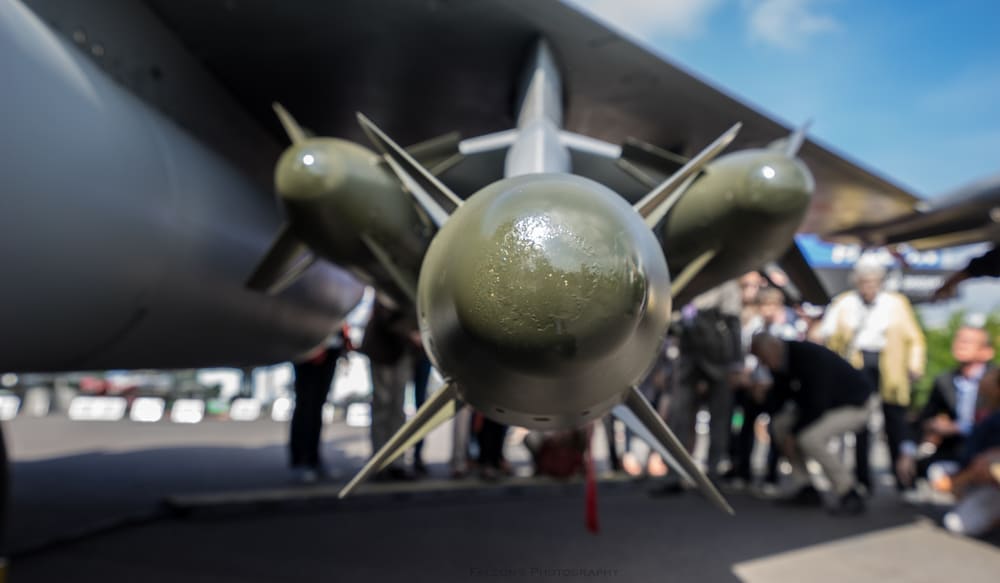
MBDA published the first photograph of its Thundart 227mm guided artillery rocket — a test round displayed on St. Barbara’s Day, the feast day recognized in France as the patron saint of artillery operators. The image arrived as European missile house MBDA and Safran Electronics & Defense accelerate development of a domestically produced surface-to-surface weapon designed to more than double the strike reach of the French Army’s current rocket artillery.
Thundart emerged from the Long-Range Land Strike program, known by its French acronym FLP-T, launched by the Defence Procurement Agency (DGA) in 2023. The program aims to deliver a tactical strike reach of 150 kilometers (93 miles), well beyond the roughly 70-kilometer (43-mile) limit of the GPS/INS guided rockets fired from the French Army’s nine Lance-Roquettes Unitaire (LRU) launchers. Those LRU systems, modified versions of the American M270 Multiple Launch Rocket System, are set for retirement in 2027, and the push for a replacement has grown under military and political scrutiny.
The French Army’s chief of staff has called the new long-range tactical strike capability “essential.” France’s 2024–2030 defense spending plan allocates €600 million to FLP-T, with the goal of at least 13 systems by 2030 and 26 by 2035 to equip a full battalion. The program plans demonstration firings for mid-2026. After that, the government will either select a preferred solution or consider off-the-shelf alternatives.
FLP-T Program
Two industrial teams are developing parallel solutions under DGA oversight. MBDA and Safran Electronics & Defense are leading Thundart. Thales and ArianeGroup have formed a rival consortium. Public detail on the Thales/ArianeGroup effort remain limited. The group has not released comparable technical information.
Work on Thundart began in late 2023. A mockup appeared at the Eurosatory defense exhibition in June 2024. A more complete presentation followed at the Paris Air Show in April 2025. The guidance package leans heavily on Safran’s AASM Hammer rocket-assisted bombs. They use a GPS-assisted inertial navigation system built for static targets. Multi-mode versions add imaging infrared or semi-active laser homing. This allows strikes on moving targets and better accuracy in GPS-denied environments.
The fire-control system derives from Safran’s design for the CAESAR self-propelled howitzer. Both Hammer and CAESAR have seen combat in Ukraine, providing the program with a foundation of battlefield-proven technology. Industry sources indicate the 8×8 wheeled launcher will carry two pods for a total of 12 rockets — matching the capacity of an M270 and exceeding HIMARS by a factor of two. Air mobility aboard an A400M Atlas transport aircraft is among the stated requirements.
MBDA completed the acquisition of Roxel in October 2025, purchasing the remaining 50% stake from Safran. Roxel, now an MBDA subsidiary, manufactured solid-propellant rocket motors for the European Guided MLRS variant and brings relevant experience to the new thruster development. According to MBDA, factories in the Centre-Val de Loire region are “geared up for the mass production of tactical ammunition in this format.”
A third contender has entered the FLP-T discussion. Turgis & Gaillard, a mid-sized French firm, developed the Foudre launcher independently and unveiled it at the Paris Air Show in 2025. Foudre is mounted on a Renault Trucks Kerax 6×6 chassis, lighter than 8×8 systems like Chunmoo, and uses a single pod carrying six 227mm M31 rockets. It can also fire ATACMS missiles with a 300-kilometer range or up to two Precision Strike Missiles (PrSM) reaching 500 kilometers. Integration of MBDA’s Land Cruise Missile, with a stated range exceeding 1,000 kilometers, is planned with minor adaptations.
Defence Minister Sébastien Lecornu has expressed interest in Turgis & Gaillard’s work. Emmanuel Chiva, head of DGA, has voiced support for involving mid-sized industrial players capable of challenging established defense groups. Foudre could reach production and begin deliveries by late 2027, whereas both FLP-T consortia face longer timelines to operational readiness.
European Rocket Artillery Procurement
Several NATO members have committed to American or other foreign systems. Estonia, Italy, Latvia, Lithuania, and Romania operate or have ordered HIMARS. Denmark, Germany, the Netherlands, and Spain selected the Israeli-made PULS (Precise and Universal Launch System), produced by Elbit Systems with a range of up to 300 kilometers depending on ammunition type. Germany is pursuing a Europeanized variant through a collaboration between KNDS and Elbit. Rheinmetall has teamed with Lockheed Martin on the Global Mobile Artillery Rocket System (GMARS), a wheeled launcher similar to MLRS.
Poland signed a major procurement deal for South Korea’s Chunmoo (designated Homar-K domestically), alongside its existing HIMARS fleet. The Homar-K platforms will fire CGR-080 guided rockets at 80-kilometer range and CTM-290 tactical ballistic missiles reaching 290 kilometers. WB Group, Poland’s largest private defense company, signed an agreement with Hanwha Aerospace in April 2025 to create a joint venture for guided munitions production.
Norway’s rocket artillery competition ended in late January 2026. The government picked Hanwha’s Chunmoo in a deal worth about $2 billion. It cited delivery timelines and cost advantages over the other bids. KNDS Deutschland’s EuroPULS left the field in June 2025. The Defence Materiel Agency said the Franco-German consortium could not deliver a complete system that met the requirements. Lockheed Martin also offered HIMARS. Chunmoo was the only bid that met every stated parameter, including munitions reaching 500 kilometers.
The United Kingdom is taking a different approach. The British Army is upgrading and expanding its M270 MLRS fleet to more than 70 platforms by the end of the decade. It has 61 launchers on order for recapitalization to the M270A2 variant. It is also considering 15 additional systems and one repair vehicle. The upgrade adds new engines and redesigned cabins. It also brings compatibility with Extended Range GMLRS, which reaches 150 kilometers, and Precision Strike Missiles, which reach 499 kilometers. The Ministry of Defence has committed £800 million over ten years for GMLRS and ER-GMLRS procurement.
Sweden had been viewed as a potential market for French rocket artillery, but procurement timelines under FLP-T appear misaligned with Nordic requirements. Defense officials confirm the Swedish government commissioned a “jet-powered UAV” development from GKN Aerospace — in practical terms, a cruise missile — with an 18-month timeline and a 2,000-kilometer range target for fielding by 2030. GKN’s Swedish subsidiary Volvo Aero is handling the jet engine.
ITAR-Free Export Advantage and European Defense Autonomy
Thundart is designed to operate outside the regulatory framework of U.S. export controls. The system will not be subject to International Traffic in Arms Regulations (ITAR), meaning Paris can export the weapon to any country without obtaining approval from Washington. This matters for third-party customers who have encountered delays, denials, or political complications when attempting to acquire American defense systems.
MBDA and Safran have put sovereignty at the center of the design. Production will stay entirely in France. This gives Paris control over future developments and the pace of manufacturing. HIMARS, by contrast, faces production bottlenecks. A French National Assembly defense committee evaluation published in October 2025 said U.S. delivery timelines starting in 2027 may not match France’s capability-gap needs. It has added to internal tension between supporters of off-the-shelf acquisition and advocates for domestic development.
The war in Ukraine sped up Europe’s recognition of gaps in long-range strike capability. NATO’s Defence Planning Process has flagged artillery shortfalls and urged Allies to address them. European armies also lacked a homegrown HIMARS equivalent. Countries shopping for rocket artillery in recent years picked American, Israeli, or South Korean systems.
The European Long-Range Strike Approach (ELSA) is a separate effort. France proposed it, and Germany, Italy, and Poland signed on at the NATO Summit in July 2024. The aim is to develop deep precision strike weapons with ranges above 1,000 kilometers. The United Kingdom and Sweden joined later. MBDA has put forward its Land Cruise Missile, a ground-based variant of the Naval Cruise Missile, as a short-term ELSA option. The DGA has asked both FLP-T consortia to study cost and feasibility for a follow-on capability with a 500 to 1,000-kilometer reach.
According to defense analysts, ELSA has not become the unifying framework originally intended. Several member countries have pursued national programs independently. The Netherlands announced an urgent need for a domestic Tomahawk alternative. France’s 1,000-kilometer Land Cruise Missile is increasingly viewed as a national project rather than an ELSA contribution. The United Kingdom launched Project Nightfall in January 2026, seeking a ballistic missile delivering a 200-kilogram warhead beyond 500 kilometers with a maximum unit price of £800,000 and a production rate target of 10 missiles per month.
France is also examining a longer-range ballistic missile project. The 2026 budget allocates €15.6 million for a feasibility study of a 2,000-kilometer maneuverable missile, with potential for hypersonic glide vehicle integration. That effort is proceeding without foreign partners.
Operational Requirements and Near-Term Timeline
Thundart is intended for high-intensity operations against logistics nodes, command posts, and air-defense radars. The architecture prioritizes autonomy, road mobility, and rapid emplacement. Digital connectivity enables integration with the French Army’s ATLAS fire control system, supporting sensor-to-shooter tasking and disciplined shoot-and-scoot tactics.
The system must operate across a wide temperature range and function off-road. Industry sources indicate the 227mm rocket will maintain backward compatibility with France’s existing LRU fleet, allowing live-fire trials from current launchers while the wheeled, podded launcher matures toward production.
FLP-T’s ambitious timeline remains a point of uncertainty. Demonstration firings by mid-2026 will inform the government’s decision. The highly compressed schedule leaves open the possibility that France may ultimately select an off-the-shelf system if domestic options fail to meet operational readiness targets by decade’s end.
Our analysis finds Thundart’s case rests on three points. France would keep sovereign control over production and exports. The system would stay compatible with proven guidance and fire-control technology. It also fits French industrial policy, which favors domestic procurement. It’s still unclear whether this will turn into export orders. PULS, HIMARS, and Chunmoo already have footholds across Europe, and the FLP-T program’s compressed development cycle may not deliver an operationally ready system fast enough to catch the remaining market openings in Norway, Sweden, or elsewhere.
The French government has said it won’t exclude foreign options if French solutions fall short of requirements. HIMARS delivery limits and ITAR restrictions point toward a sovereign route, but decision-makers will weigh readiness, cost, and interoperability with allied forces.
REFERENCE SOURCES
- https://www.mbda-systems.com/thundart-french-solution-replace-unitary-rocket-launcher
- https://www.safran-group.com/news/thundart-future-long-range-rocket-made-france-2025-10-22
- https://www.army-technology.com/news/mbda-thundart-rocket-systems/
- https://www.defensenews.com/global/europe/2025/04/10/france-plans-to-test-homemade-himars-alternative-by-mid-2026/
- https://www.twz.com/land/french-thundart-rocket-unveiled-as-longer-range-alternative-to-himars
- https://www.armyrecognition.com/news/army-news/2025/france-to-test-thundart-rocket-launcher-to-rival-u-s-himars-in-2026-demonstrations
- https://defence-industry.eu/thundart-frances-new-long-range-rocket-artillery-system-set-for-demonstration-firings-in-2026/
- https://militarnyi.com/en/news/mlrs-thundart-mbda-and-safran-present-new-french-rocket-system/
- https://www.edrmagazine.eu/pas-2025-safran-and-mbda-detail-thundart-their-proposal-for-the-french-army-flp-t-programme
- https://www.defensenews.com/global/europe/2026/01/29/norway-picks-hanwha-to-supply-rocket-artillery-in-2-billion-deal/
- https://www.janes.com/osint-insights/defence-news/land/future-artillery-2025-uk-to-receive-first-upgraded-m270-mlrs-this-year
- https://www.armyrecognition.com/archives/archives-land-defense/land-defense-2024/british-army-to-double-its-fleet-of-m270-mlrs-by-2029
- https://www.aerotime.aero/articles/uk-nightfall-ballistic-missile-ukraine
- https://www.defensenews.com/global/europe/2025/05/05/europes-long-range-strike-project-nears-choice-of-lead-contractors/
- https://euro-sd.com/2025/09/articles/armament/46050/europes-dash-to-procure-rocket-artillery/