An interceptor that works costs more than the thing it destroys, and there are fewer of them than anyone would like. That exchange ratio has become the organizing problem of modern weapons development. A one-way attack drone assembled for a few tens of thousands of dollars can force the launch of a missile costing several million, and no magazine survives that trade for long.
This section covers the effectors and the software around them. Missiles and munitions, unmanned systems, air and missile defense, electronic warfare, cyber, lasers and high-power microwave, autonomy, propulsion, and the mission software that decides how quickly any of it can be changed.
Demonstrations are treated as demonstrations. A laser that shot down a drone on a range in good weather is not a fielded capability, and coverage says which one it is.
Production rate matters as much as performance. A weapon nobody can build at scale is a briefing slide.
The Defense Advanced Research Projects Agency has shut down its three-year effort to build the Liberty Lifter, a heavy-lift seaplane that would skim above waves on a cushion of air. According to industry sources, the agency notified performers on July 12 that
Project Revolver has moved from lab study to fleet priority in less than three years. Senior officers at the Office of Naval Research (ONR) now describe the program as "an essential magazine-depth booster for fast-attack boats operating west of Guam." Defense officials
The Paris Air Show gave America's biggest defense suppliers a global stage to describe how they would fold familiar missiles, radars and command-and-control networks into President Donald Trump's Golden Dome homeland-defense plan. They argued that starting with hardware already in service will
European armies just wrapped up three weeks of hands-on trials that pushed small drones and ground robots through the same last-mile supply missions now common on Ukrainian front lines. Engineers and soldiers moved ammunition, water, and medical kits without a single crewed
The Army is moving fast to fold a new hypersonic strike option into its tactical fires family. Budget lines for fiscal year 2026 outline Project HX3, a pathway that funnels $25 million toward Castelion's Blackbeard Ground Launch missile and an autonomous launcher
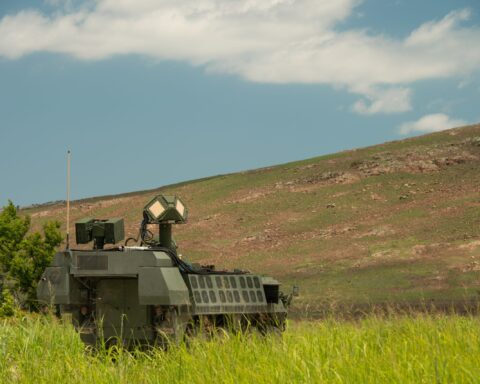
Soldiers at Fort Sill fired a Stryker-mounted laser in a real tactical drill for the first time. The short event lasted only minutes, yet it closed a twenty-year gap between early laboratory trials and practical field use. Defense officials confirm that the
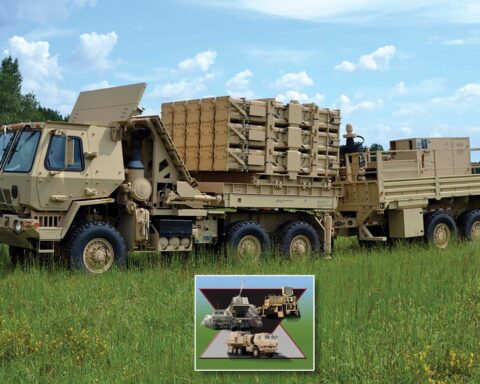
The Army has given the green light to start low-rate production of its Indirect Fire Protection Capability Increment 2 system this October. Defense officials confirm that the signed acquisition decision memorandum cleared the final gate after a quick turn-around review on 28
Germany has opened a new front in its security agenda. Interior Minister Alexander Dobrindt, during a 48-hour visit to Israel, said Berlin will build a joint cyber research center with Israeli partners and anchor a nationwide "Cyber Dome" to shield critical networks
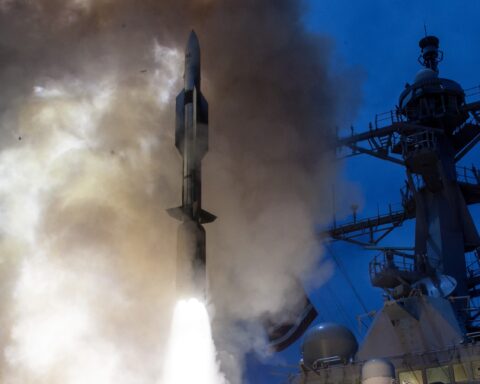
The U.S. Navy built its Fiscal Year 2026 weapons plan around one assumption. Congress will pass a one-time reconciliation bill that adds billions to the base defense budget. Inside that bill sits most of the money for 139 Standard Missile-6 interceptors. The
The Defense Advanced Research Projects Agency has closed the books on its Demonstration Rocket for Agile Cislunar Operations program. Defense officials confirm the termination order went out late Monday. The move ends a five-year push to field a nuclear-thermal upper stage able
Missiles / Drones / Directed Energy carries the effectors: cruise and ballistic weapons, loitering munitions, unmanned systems, and the lasers and high-power microwave now being fielded against them. What all of it is aimed at, and what shoots it down, is in Air & Missile Defense Systems.